
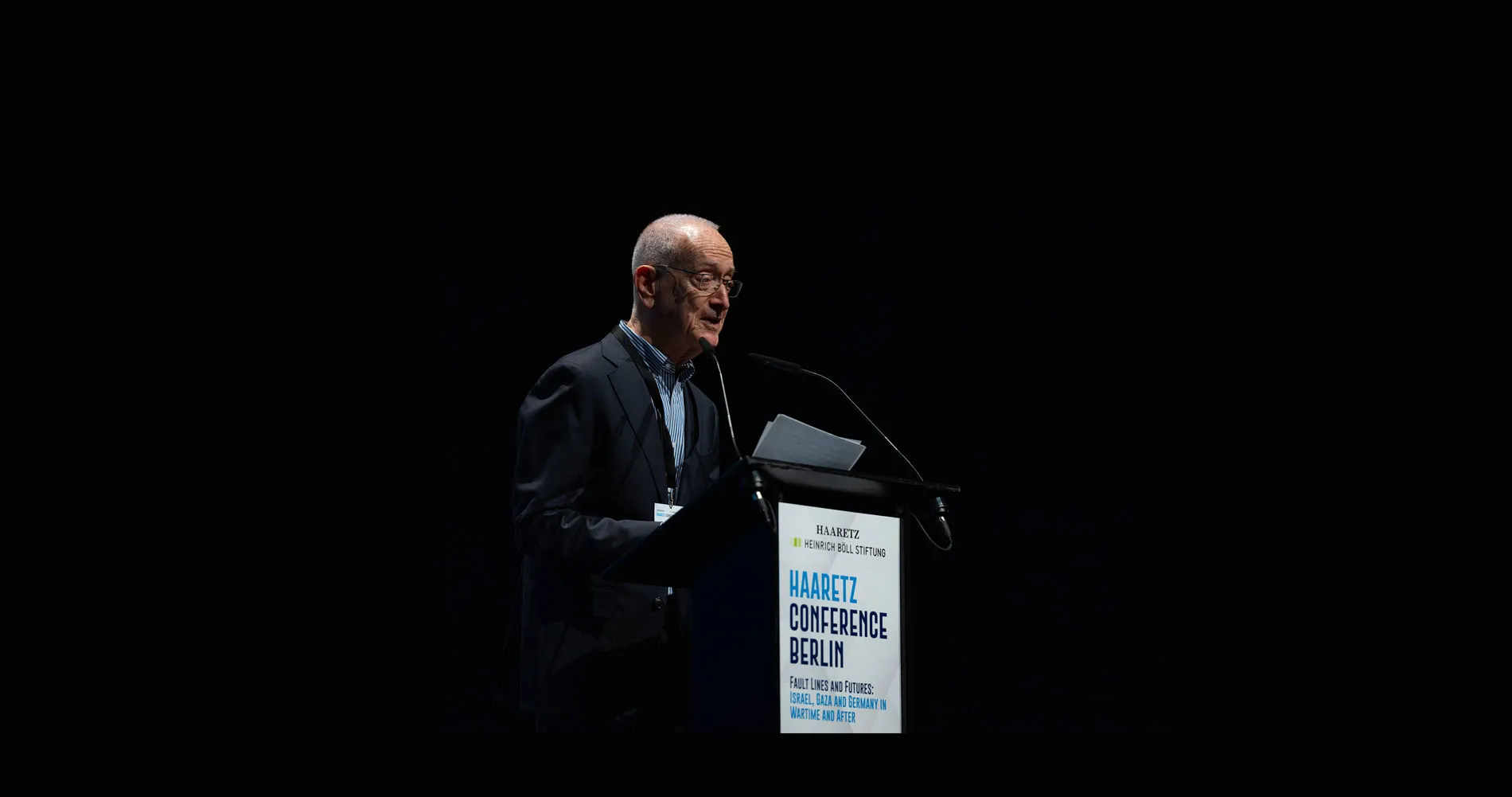
On 6 November 2025, the highly respected Israeli newspaper Haaretz held its first-ever international conference in Germany at the Haus der Berliner Festspiele. The event, co-organized with the Heinrich Böll Foundation (affiliated with Germany’s Green Party), addressed the aftermath of October 7 and the Gaza war, as well as the overall feasibility of a two-state solution and the role of global actors in the Israeli-Palestinian conflict. How does the conference resonate ten months later?
Anna-Sanziana Beschia
10 August 2026
Held barely one month after the October 2025 ceasefire, the Haaretz international conference in Berlin was a remarkable event which did not receive the international attention it deserved. The conference brought together over 30 journalists, artists, researchers, and politicians, among whom were former Israeli Prime Minister, Ehud Olmert, and former Palestinian Minister of Foreign Affairs and Member of the Fatah Central Committee, Nasser Alkidwa.
The panelists tackled many hotly debated topics, from the Israeli government’s assault on democracy, to freedom of the press, the boycotts of artists, and not least, Germany’s special relationship with the state of Israel. In such polarized times, the conference was a rare occasion for non-antagonistic, true dialogue among Israelis, Palestinians, and members of the international community.
Dr. Ofer Waldman, head of the Tel Aviv office of the Heinrich Böll Foundation (which operates in about thirty countries), got to the crux of the matter when he argued that much of the international debate surrounding the Israeli-Palestinian conflict is framed in terms of either standing with international law or with Israel. Yet, he insisted, the two must go hand in hand; this cannot be an either-or choice. Israel can only have a future alongside an independent and democratic Palestinian state. This view was equally shared by Ehud Olmert and Nasser Alkidwa who both view the two-state solution as the only viable solution for Israel and Palestine. Alkidwa pointed out that while it is a good sign that the international community is once again engaged in such debates, “Palestinians need tangible things”, and reiterated that “we cannot afford not to be hopeful”.
Indeed, hope was in the air in Berlin on November 6, only a few weeks after the Trump administration brokered the ceasefire. On this matter, Hiba Qasas, Palestinian-born founder and director of Principles for Peace, a Geneva-based organization, argued that Trump is good at “creating a sense of urgency” and that there is a collective responsibility to channel it in the right direction. Qasas added that we find ourselves in a moment of great opportunity, but that great opportunity also comes with great risk.
The panelists unanimously agreed that democracy in Israel is in a dire state today. Eran Etzion, former deputy head of Israel’s National Security Council, reminded the audience of Netanyahu’s “two-pronged strategy”: to kill the Oslo accords and any chance at a two-state solution, and to change the nature of Israel’s intellectual elites from liberal to ultraconservative. On this latter topic, Franco-Israeli sociologist Eva Illouz also observed that “liberal social-democrat Jews who believe in international law and human rights have never been so lonely”. Furthermore, Etzion added that removing Netanyahu in the next elections is an opportunity that must not be missed and, according to him, the key to overcoming the current Israeli deadlock.
This view was also shared by Michael Sfard, human rights lawyer and international human rights expert, who has brought several cases before the Israeli Supreme Court, challenging the occupation and defending Israeli human rights groups. While most guests directed their criticism at the Israeli government, and at Netanyahu in particular, Sfard went a step further in questioning the Israeli society as a whole. He expressed his disbelief at witnessing the silence of many of his compatriots in the face of the horrors perpetrated in Gaza. He cited as examples teachers’ unions not condemning the destruction of the Gaza school system or doctors’ associations not condemning the annihilation of the Gaza health system. He argued that healing needs justice, something that Netanyahu’s government is utterly unable to provide.
Sfard further highlighted the critical situation the International Criminal Court and the International Court of Justice find themselves in today due to US sanctions. He argued that the international community, and countries like Germany, should support more such institutions, which, in his view, is not something they currently do.
As a reminder, the ICC issued arrest warrants for Netanyahu and former defense minister, Yoav Gallant in November 2024, and South Africa brought a case before the ICJ in December 2023, accusing the state of Israel of violating the Genocide Convention during the Gaza war. On 1 March 2024, Nicaragua filed a case at the ICJ accusing Germany of facilitating genocide in Gaza through military and financial support for Israel and cutting aid to UNRWA. The ICJ rejected Nicaragua’s request for emergency provisional measures, but the core lawsuit remains active.
As expected, Germany’s special relationship with the state of Israel was one of the central themes of the Berlin Haaretz conference. Franziska Brantner, MP for the Green Party, pointed out that neither the EU, nor Germany in particular, have been able to be that strong European voice in the region. This role is thus far effectively left to the US and its current President, Donald Trump.
Other voices, however, were more critical. Political campaigner for Campact e.V., Ann- Katrin Seidel, questioned whether Germany should use its voice to suspend the EU-Israel Association Agreement (currently a hotly debated topic in Brussels). Germany has blocked the suspension of the Agreement thus far. According to its website Campact “brings together over 4.25 million people who are committed to progressive politics and defending our democracy”. It is a prominent German non-governmental organization that aims at creating political pressure through mass digital mobilization.
Another grassroots organization is “Justice for Palestine”. It is a European Citizens’ Initiative (ECI) which gathered nearly 1.3 million signatures before closing the list. It calls for the full suspension of the EU-Israel Association Agreement. Having crossed 1 million verified signatures, the initiative legally compels the European Commission to formally examine the proposal, meet with organizers and hold a European Parliament hearing. “Justice for Palestine” is supported by a broad coalition of green-left parties and various grassroots civil society and human rights groups across the European Union. Moreover, Oxfam has gathered over 60+ organizations who have signed an open letter to Commission President von der Leyen to suspend the EU-Israel Association Agreement.


To borrow the words of Hiba Qasas, how have we managed to “channel” the “sense of urgency” created by Trump since the 10 October 2025 ceasefire? As things stand, Human Rights Watch reports that the humanitarian infrastructure in Gaza is precarious nine months after the ceasefire agreement. At least 1150 Palestinians have been killed and 3750 others wounded since the ceasefire according to the Gaza Health Ministry.
In a recent development Hamas agreed to the US-backed framework that would ultimately see the militant group give up its weapons and control of Gaza, while Israeli forces withdraw from the territory. Yet the IDF has stated it will not withdraw before Hamas disarms.
Since the ceasefire, Israeli forces have moved the agreed limit of Israeli territorial control in Gaza further westwards, establishing over thirty outposts and constructing a seemingly permanent barrier, according to satellite images published by Haaretz. Doctors Without Borders in Gaza warns that as the line moves west, it swallows water access points and health facilities.
In addition, Trump’s 20-point peace plan, officially known as The Comprehensive Plan, includes a Board of Peace with no Palestinian representation, and Israel has yet to fulfill all its commitments agreed upon on the plan. To make matters worse, humanitarian deliveries remain below the pre-February 28 level, when the US and Israel launched a war against Iran. While commercial trucks deliveries have increased in May, they still fall short of Gaza’s needs.
On 6 August the United Arab Emirates joined seven other Muslim-majority nations in issuing a strongly worded joint statement condemning Israel’s military actions in the Gaza Strip and accusing it of jeopardizing US President Donald Trump’s roadmap to end the war. This rare show of Muslim unity by the foreign ministers of the UAE, Qatar, Jordan, Indonesia, Pakistan, Türkiye, Saudi Arabia and Egypt, held that Israel’s continued military operations were undermining international efforts to implement the next phase of the Gaza peace plan after Palestinian factions accepted the framework announced by Trump.
Against a backdrop of increased settler violence in the West Bank and the controversial death penalty law Israel passed on 30 March 2026, it is becoming increasingly difficult to revive the optimism of the Berlin Haaretz international conference. The death penalty law, which came into effect on May 17, has been criticized as discriminatory since “it states that it does not apply to Israeli citizens or residents of Israel”, but only to “terror trials in the military courts system, which is used for Palestinians, while Israelis are tried in Israel’s civilian court system”, reports the Times of Israel.
As emphasized during the conference, there may still be a beacon of hope in Israel’s upcoming fall elections. For now, it is not too optimistic to say that events like the Haaretz international conference remain essential for intellectual exchange and political dialogue in an increasingly polarized environment