
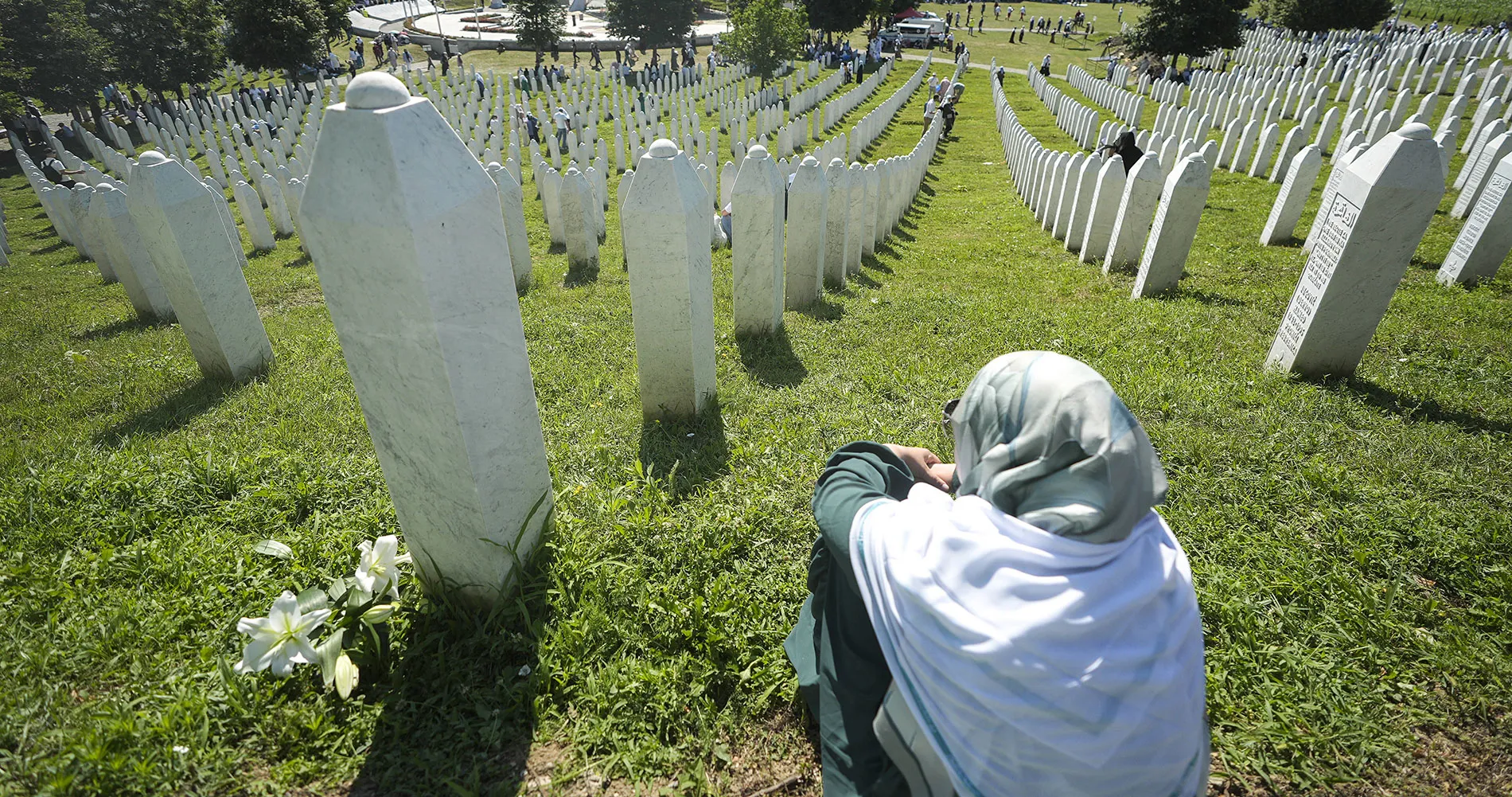
Every year on July 11, the world observes the International Day of Remembrance for the Victims of the 1995 Srebrenica Genocide. This date has gone down in infamy and is dedicated to the memory of more than 8000 Bosnian Muslim men and boys who were killed during the Bosnian War. Yet the horror of war did not stop there. The besieged civilians of Sarajevo were monetized for hunting tourism. These hunters allegedly paid for the chance to fire on live humans. Now Italian courts are racing against time to serve justice.
Jessica Hall
13 July 2026
The world remembers Sarajevo as the bleeding heart of the Bosnian war. Far less known is one of the conflict’s most grotesque allegations: the “Sarajevo Safari”. Adorned in expensive hunting gear, tourists reportedly traded stacks of cash with Republika Srpska soldiers for the chance to lie in wait in the hills above the city, where they were handed loaded rifles to kill civilian men, women, and children below.
Sadly, history has repeated itself. A recent June 2026 report by the UN Independent International Commission of Inquiry on the Occupied Palestinian Territory, including East Jerusalem, and Israel determined that Israeli authorities and security forces are deliberately targeting Palestinian children.
In 1991, the Socialist Federal Republic of Yugoslavia began to disintegrate as several of its republics moved towards independence. This process was anything but peaceful.
Bosnia and Herzegovina, a deeply multi-ethnic republic of Bosniaks, Serbs, and Croats, faced immediate tension following its 1992 declaration of independence. Many Bosnian Serbs rejected the new state and sought alignment with Serbia, leading to the creation of the proto-state Republika Srpska, while Bosnian Croat leaders established the Croatian Republic of Herzeg-Bosnia with support from Croatia.
By March 1992, violence had erupted. Under the leadership of Radovan Karadžić, Republika Srpska forces, supported by the Yugoslav People’s Army, launched a systematic campaign of siege warfare, forced displacement, and ethnic cleansing targeting the Bosniak population.
The capital, Sarajevo, was encircled in what became the longest siege of a capital city in modern warfare. Civilians endured constant shelling, sniper fire, and severe shortages of basic necessities. Across the country, Bosnian Serb forces rapidly gained control of large areas of territory.
Despite the presence of United Nations peacekeepers, violence continued. In July 1995, the Srebrenica massacre saw more than 8000 Bosniak men and boys killed after a UN-designated “safe area” did not live up to its name. The Dutch peacekeepers failed to protect the civilian population – instead they facilitated the genocide. July 11 is a day of remembrance of the genocide committed under the watchful eye of the UN.
Later that year, the Dayton Agreement ended the war. By then, over 100 000 people had already been killed and more than 2 million had already been displaced.
It was within this atmosphere of siege, violence, and fear that the so-called “Sarajevo Safari” took place. During the siege, the elevated positions in the hills surrounding Sarajevo were used by Republika Srpska forces for artillery and sniper fire.


Much of the evidence today comes from those who witnessed it firsthand, speaking out in the pursuit of justice. Among the most prominent accounts is Sarajevo Safari, a 2022 documentary by Miran Zupanič, which tells the story through the voices of those who lived through it from a victim perspective.
This was not incidental violence. It was coordinated, calculated, and deliberate. According to multiple accounts, individuals, reportedly mostly from Italy, but also from other countries, paid large sums for the opportunity to fire on civilians. Some reports suggest payments reaching up to EUR 100 000.
One of the figureheads of this public movement, who was also featured in the documentary, is Edin Subašić, a former Bosnian intelligence officer. He has described receiving intelligence indicating that civilians were deliberately targeted, with reports of differential “pricing” based on vulnerability. Children and pregnant women cost more than men.
After paying substantial sums to the Republika Srpska organizers, these “sniper tourists” were allegedly transported into the region, often flying first to Trieste and then onward to Belgrade, before being taken to positions overlooking the city and provided with weapons. As commercial access to the region became increasingly restricted in wartime, some accounts describe the use of covert transport methods – including vehicles disguised as humanitarian or medical transport – to move individuals to sniper positions.
Perhaps most chilling was the calculated, transactional nature of it all – designed so that the killing of civilians did not disrupt the lives of those behind the gun. The “sniper tourists” were reportedly able to arrive after work on a Friday and be back home by Sunday evening, as if it were nothing more than a weekend trip.
The organizers went beyond logistics, reportedly guiding individuals to vantage points above neighborhoods selected for maximum exposure. Conducting sniper tourism in areas such as Grbavica, a densely populated district bordered by elevated terrain, is proof that such locations where not chosen by chance, but by design.
It appears the knowledge of this tourism was known not only to civilians, but may also have reached government officials. Subašić also claimed that the intelligence he received on the issue was shared with SISMI, Italy’s military intelligence service at the time, though no action followed. Republika Srpska forces benefited from the broader fog of war they had helped create.
Recent years have seen renewed attention to these allegations, driven largely by those who have spoken out and documented their experiences. This has ignited legal scrutiny.
In 2025, prosecutors in Milan opened an investigation following evidence compiled by journalist Ezio Gavazzeni. His work – including a 17-page dossier prepared for the court and his book I cecchini del weekend (The Weekend Snipers) – has been central in bringing the issue back into public view.
With the support of legal teams, testimonies have emerged suggesting that some Italian citizens were aware of, or involved in, these acts. Former Italian diplomat Michele Giffoni, who served in Sarajevo during the war, has also publicly acknowledged the existence of such accounts. Prosecutors are treating the case not as an isolated incident, but as part of a potentially wider pattern of organized violence.
No convictions have yet been secured, and the number of sniper tourists remains unknown. It is also unclear how many of the perpetrators or witnesses are still alive. Prosecutors are racing against time to serve justice.