
Intermittent methane bursts and a recent study of organic molecules in Martian rocks make the possibility of life on Mars — past and present — even more likely.
Anna-Sanziana Beschia
22 April 2026
Humanity has been pondering the possibility of life on Mars since the end of the 19th century. NASA’s Viking mission to Mars in 1975 brought us the first images of the red planet. Recent studies on organic molecules and intermittent methane bursts could hint at past, or even present, forms of microbial life on the red planet. Could our neighboring planet be hiding life under its red dusty atmosphere?
Over 4 billion years ago, Earth and Mars were thought to have been quite similar. Early Mars had water in the form of lakes, oceans and rivers, a protective atmosphere, and even geothermal activity and hot springs. In other words, it exhibited the same features conducive to the emergence of life as Earth did. Then, Mars’ magnetic field collapsed, its atmosphere disintegrated and Mars froze and was left exposed to ionizing radiation from space.
Fast forward to the present where scientists are to determine whether that early Martian environment did in fact host a primitive life form. More intriguingly, could life still exist underneath Mars’ icy and barren surface?
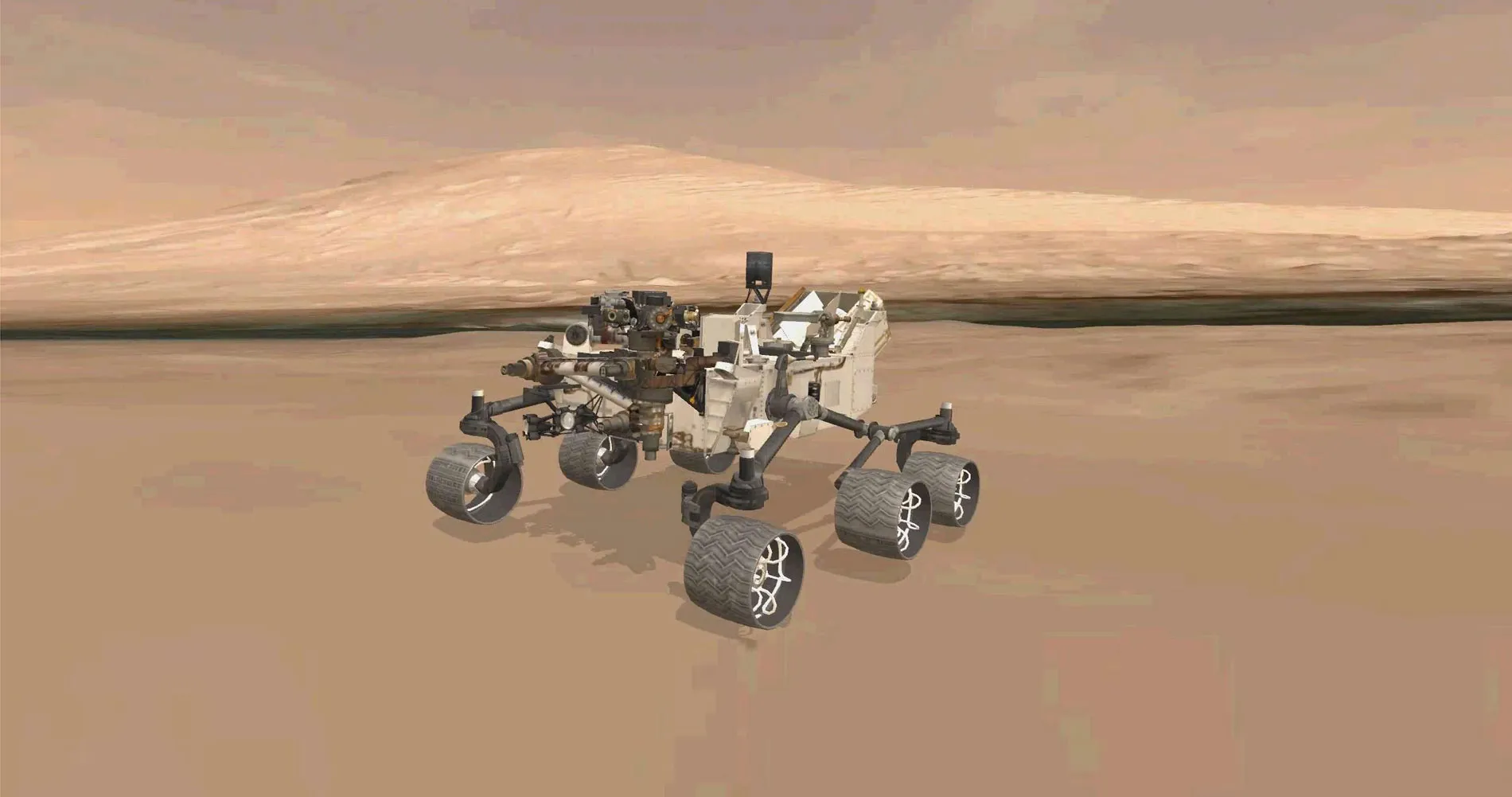
SAM, or Sample Analysis at Mars, is a portable chemistry lab aboard NASA’s Curiosity rover which has explored Gale Crater on Mars since 2012. While methane had been detected sporadically in the past, SAM reported the largest methane burst (or plume) on Mars in 2019. Moreover, this discovery pointed to an even more curious phenomenon as methane bursts appeared to be part of a seasonal cycle, rising at night and disappearing during the day with seasonal fluctuations.
On Earth, methane is usually produced by living creatures and organisms, raising the possibility that the gas’ strange behaviour on Mars could, in fact, point to a potential biosignature, a sign of past or present life. Yet NASA scientists have clarified that methane can also have non-biological origins since it can be produced via geological processes involving water and rocks deep underground.
Another explanation for the sudden release of methane could be caused by the rover driving over salt crusts. The gas might be trapped under the salt crusts That is why this phenomenon has only been detected on the surface around Gale Crater where Curiosity is deployed.
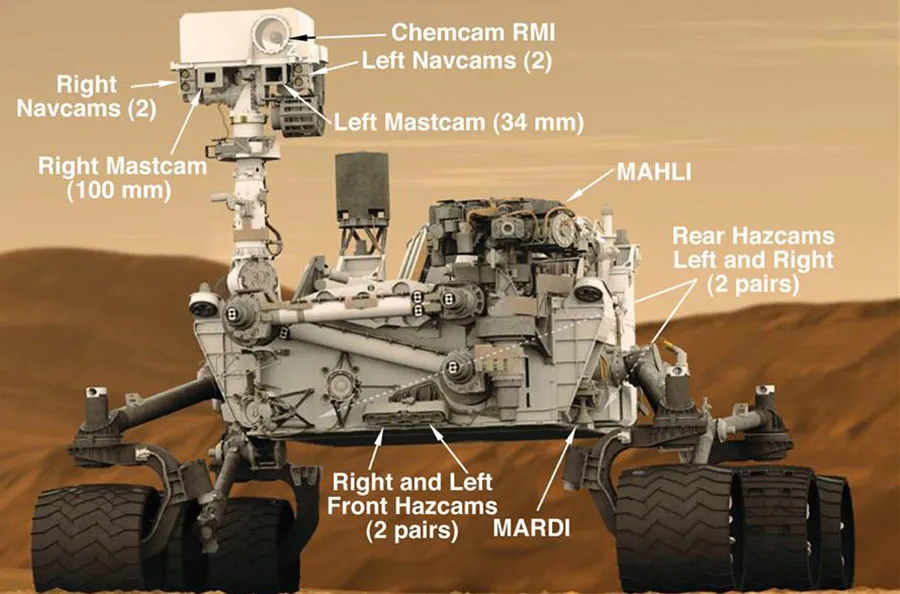 Seventeen Cameras on Curiosity Artist Concept, Secondary Creator Credit: NASA/JPL-Caltech
However, there is renewed hope after a recent study was published in the journal Astrobiology, in March 2025, focussing on organic molecules from a Martian rock known as “Cumberland”. Organic molecules (molecules that contain carbon and hydrogen bonds) are the building blocks of life on Earth. Yet just like methane, organic molecules can have non-biological origins. Kevin Olsen, Mars Science Fellow at the UK Space Agency, explains that these larger organic compounds could have also been formed by hydrothermal reactions involving high heat and water underground, delivery via space dust and meteorites, or chemical reactions in the early Martian atmosphere.
Nevertheless, it appears that scientists are not fully convinced by these explanations. Indeed, the study argues that high concentrations of carbon-based molecules cannot be entirely explained by the non-biological processes mentioned above. In addition, results from another NASA rover, Perseverance, corroborate these findings. While there is no definitive proof yet of an ancient Martian biosphere, it certainly looks highly plausible.
But could there still be life on Mars today? On Earth, life has been found in the most inhospitable places and there is still so much we don not know about what lurks underneath our own surface. Indeed, about 70% of bacteria and microorganisms live in Earth’s deep biosphere and drilling that far into our own planet is a considerable challenge.


What, then, can we say about Mars, whose surface we have barely scratched? Underneath the red planet’s icy surface, there may lie a biosphere in a warmer environment. It is certainly a hypothesis worth exploring and it looks like Mars missions will not cease in the near future. In fact, the European Space Agency is scheduled to send its Rosalind Franklin rover to Mars in 2028, capable of drilling up to two metres underneath the Martian surface.
Even so, scientists argue that the only way to know more about the origins of methane and organic molecules on Mars, is to bring Martian rocks back to Earth for analysis. Olsen reports that this is a “rallying cry” for the Mars Sample Return mission. The Mars Sample Return, a highly sophisticated joint endeavour by NASA and the European Space Agency, has effectively been cancelled due to its high cost estimated at around 11 billion dollars.
For the time being, we may have to temper our enthusiasm and settle for the probability that Mars likely hosted some form of life, billions of years ago. The more eccentric among us may even toy with the idea that life on Earth has Martian origins. According to this theory, a collision with Martian meteorites brought life to our planet. An intriguing theory, which lacks any solid proof – up to now….