
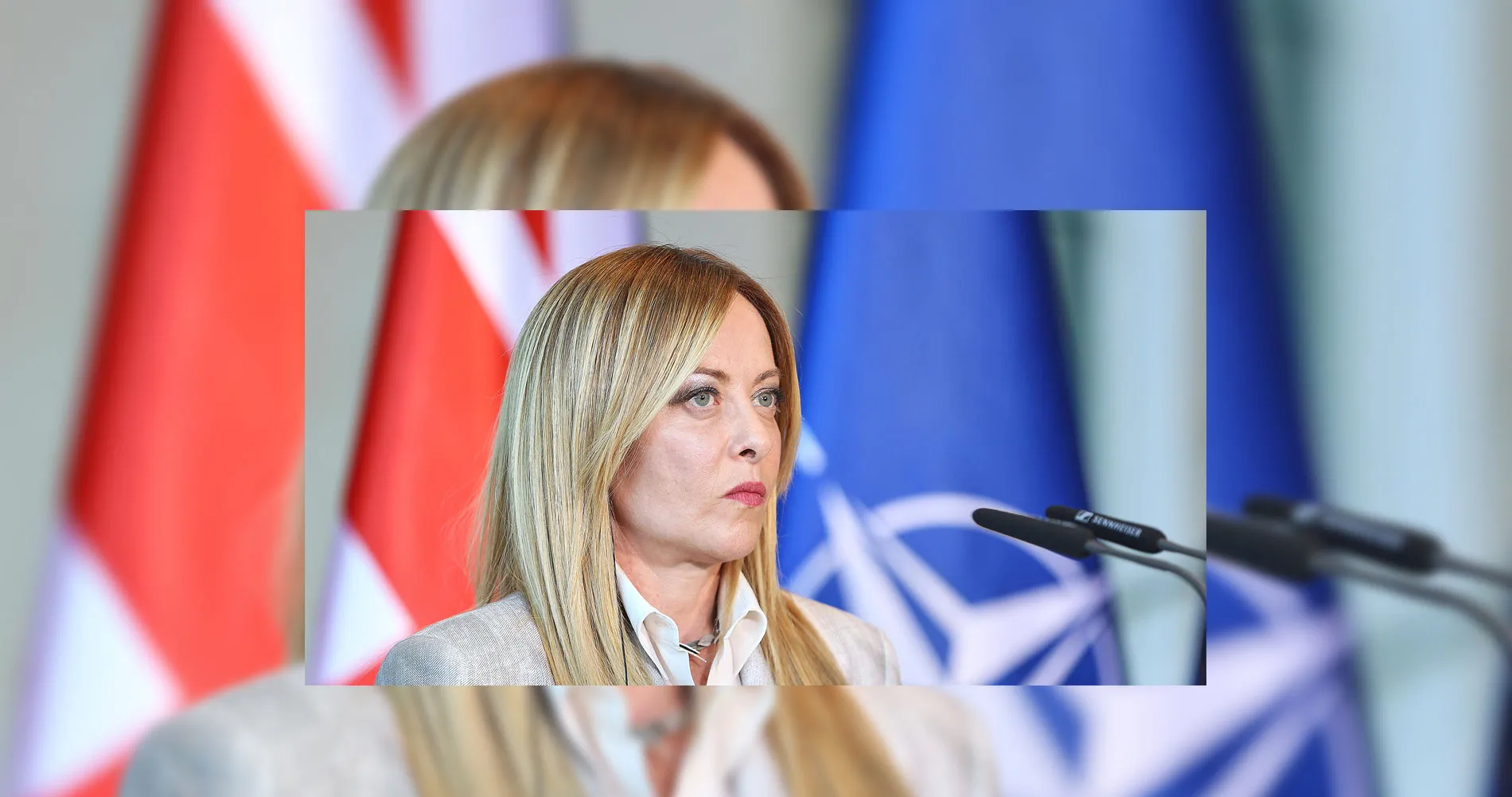
Once seen as Donald Trump’s closest ally in Europe, Giorgia Meloni is recalibrating Italy’s foreign policy. The war in the Middle East, energy insecurity and a rare clash between Washington and the Vatican initiated the fallout with President Trump. By defending Pope Leo XIV, suspending the defence agreement with Israel and accelerating gas diplomacy from the Gulf to the Caucasus, Meloni is asserting greater autonomy and strengthening Italy’s European role. She made clear that Italy is a sovereign nation.
Silvia Caschera
1 July 2026
“I am not anti-American today; I was not kneeling yesterday. I am a person who believes that the West is stronger united, who believes that Italy is stronger in a united West, and has worked and continues to work for this. After that, however, solid relationships are also based on frankness, and I am a frank person.” Meloni’s statement on Italian news agency ‘10 minuti’ on Rete 4.
By all definitions Giorgia Meloni is one of the most successful Italian politicians. Not only is she the first woman to hold the office of Prime Minister, but she also heads the second-longest government in the history of the Italian Republic.
Though some might argue that this move towards more independence from Washington was long overdue, the move is significant by reflecting a genuine adaptation to changing geopolitical realities. For years, Meloni’s was considered a close ally and friend of President Trump. Both share a political language rooted in national-conservatism, scepticism toward globalisation and criticism of liberal elites in Brussels. These policies defined her international profile and led to her election victory in 2022.
The most visible rupture occurred over the Vatican. When Trump launched harsh attacks against Pope Leo XIV on 12 April, accusing him of weakness for condemning war and denouncing the “tyrants” destabilising the Middle East, Meloni openly broke ranks. She called his remarks “unacceptable,” insisting that it is both “normal and right” for the Pope to advocate peace. By supporting the Pope and reaffirming the Vatican’s moral authority, she signalled to Italy’s Catholic electorate that her government would not tolerate attacks on the Vatican and the Pope.
Trump reacted by branding Meloni herself “unacceptable” and declaring their relationship altered. This confirmed that this altercation marked a genuine fracture with a once privileged ally. After Trump’s comments on Meloni, Italian Foreign Minister and Deputy Prime Minister Antonio Tajani cancelled his visit to Miami in early June.
Trump reignited tensions on 20 June by telling an Italian TV journalist that Meloni had “begged” him for a picture at the G7 meeting in France. Meloni rebuked Trump’s statement in a social media post, asserting that the claim was “made up”. She expressed her amazement that the US President apparently treated his allies worse than his adversaries, adding : “I do not beg, nor does Italy.”
Beyond the Vatican, the US/Israeli offensive war on Iran has accelerated Italy’s repositioning. While Washington is trying to back away from its unconditional support for Israel, Rome is increasingly focused on the economic and social consequences of the war in Middle East. Italy’s structural dependence on gas means any instability involving Iran, particularly around the Strait of Hormuz, translates immediately into fears of supply disruptions and price spikes.
Meloni is also redefining Italy’s relationship with Israel, especially after Israel’s treatment and torture of Flotilla activits, some of whom were Italian, for which Prime Minister Giorgia Meloni has demanded an explanation and official apology from Israel. The deteriorating Israeli-Italian relations were on full display when the Israeli ambassador was summoned on 20 May “to seek formal clarification” over what Italy describes as “utter disregard shown towards the Italian Government’s explicit requests.”
Italy has also sharpened its rhetoric on Lebanon. Foreign Minister Antonio Tajani has condemned what he described as “unacceptable attacks” on civilians, adopting a firmer tone than many Western counterparts. This has contributed to tensions with Israel, including diplomatic friction. Meloni insists on proportionality and respect for international law. The right to self-defence is not limitless.


The clearest policy shift of this repositioning is Italy’s decision not to renew Italy’s defence cooperation agreement with Israel. This pact covers military collaboration, technology exchange and joint research. It was suspended “in consideration of the current situation.” The move suggests that Rome is unwilling to be perceived as an unconditional supporter of Israeli operations, particularly amid accusations of violations of international law and international humanitarian law in Gaza, Lebanon and Iran.
Rather than an isolated gesture, the suspension fits into a broader strategy: regaining diplomatic flexibility between Washington, Israel and European partners, while preserving Italy’s political and moral credibility. It also allows Meloni to reposition Italy within the European debate on the Middle East as a potential bridge between competing approaches.
This evolution also aligns, implicitly, with the Vatican’s emphasis on civilian protection and moral restraint. By echoing those concerns, Meloni has strengthened her domestic legitimacy while differentiating her government from more uncompromising pro-Israel positions from Berlin.
In order to deal with the rise in energy prices because of the war on Iran, Meloni’s government has intensified diplomatic engagement with key energy suppliers, strengthening ties with Algeria and touring Gulf capitals including Saudi Arabia, Qatar and the United Arab Emirates. At the same time, Italy has reinforced the Caucasus route, deepening relations with Azerbaijan as a strategic gas hub through the Trans Adriatic Pipeline. These efforts are explicitly framed as essential to “national energy security” in a volatile geopolitical environment. Preventing geopolitical crises from triggering economic backlash at home has become central to Rome’s foreign policy calculus, reshaping priorities.
Meloni has also sought to anchor Italy more firmly within the European framework. Her participation in the Paris talks in mid-April on maritime security in the Strait of Hormuz, alongside Emmanuel Macron, now-former PM Keir Starmer and German Chancellor Friedrich Merz, underscored a willingness to act through European coordination. With the United States reluctant to engage multilaterally, she asserted that Italy is “ready to do its part,” even signalling potential naval contributions.
Meloni’s defence of the Pope, caution on Iran, energy diplomacy and shift on Israel reveal a different Meloni. She is no longer the European face of Trumpism, but a leader willing to make tough decisions. She has reasserted Italy’s sovereignty, while balancing Atlantic loyalty, economic necessity and domestic sensitivities. This proves that she is beyond ideology and is willing to do the right thing when circumstances change.
Italy is a bridge in the Mediterranean, Europe’s second industrial power, the world’s fourth largest trader and an essential partner in Africa, the Balkans, and the Middle East. The US needs Europe and Europe needs Italy. United the West is stronger than divided. The NATO summit in Ankara from 6 to 8 July will offer the next opportunity to make a show of unity and move beyond the banter of social media posts and accusations.
Minister Tajani summed it up : “At the point where we need to tone it down and work. Foreign policy is not made with insults and the latest unmotivated attacks, to which we were justified in responding. Being a loyal ally of the United States, as we are, does not mean giving up our sovereignty: we are subjects of no one. Now we need to avoid all this turning into political, economic, and diplomatic damage: Italy and Europe need a solid relationship with the USA, just as the USA needs Europe and Italy.”