
The revival of the historic Hejaz Railway and the reopening of land corridors through Syria showcase a transformative shift in Middle Eastern logistics and infrastructure-led diplomacy. By connecting Istanbul to the Gulf via Damascus and Amman, regional powers are solidifying economic integration and infrastructure to bypass traditional maritime bottlenecks. This old/new route will secure independence from IMEC: the US-led corridor through Israel’s Haifa port.
Meric Sentuna Kalaycioglu
5 August 2026
Russian version
“If goods don’t cross borders, soldiers will”. The quote is attributed to the 19th-century French economist Frédéric Bastiat and rephrased by Otto T. Mallery in his 1943 book Economic Union and Durable Peace as “countries who trade do not go to war”. The old/new Hejaz Railroad will help secure peace in the Middle East as Türkiye, Syria, Jordan and Saudi Arabia move to restore the land and rail corridors.
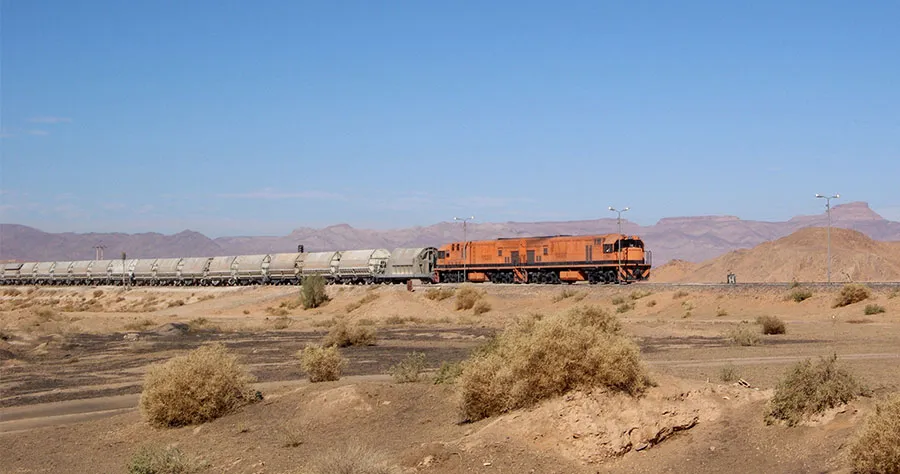
The initiative centers on the modern revival of the Hejaz Railway, a line originally designed to connect Damascus with Medina and facilitate travel, trade and pilgrimage routes across Ottoman territories at the turn of the 20th century. Large sections were damaged during World War I and later became obsolete as the modern borders, conflicts and alternative transport routes reshaped the region.
More than a century later, the railway is returning to regional discussions under very different conditions. Syria’s gradual reintegration into regional diplomacy after years of civil war, combined with Gulf-backed reconstruction interest and Türkiye’s search for new trade routes, has created momentum for infrastructure projects that were politically impossible only a few years ago. This project has become even more relevant since the ongoing Hormuz debacle caused by the US/Israel war on Iran.
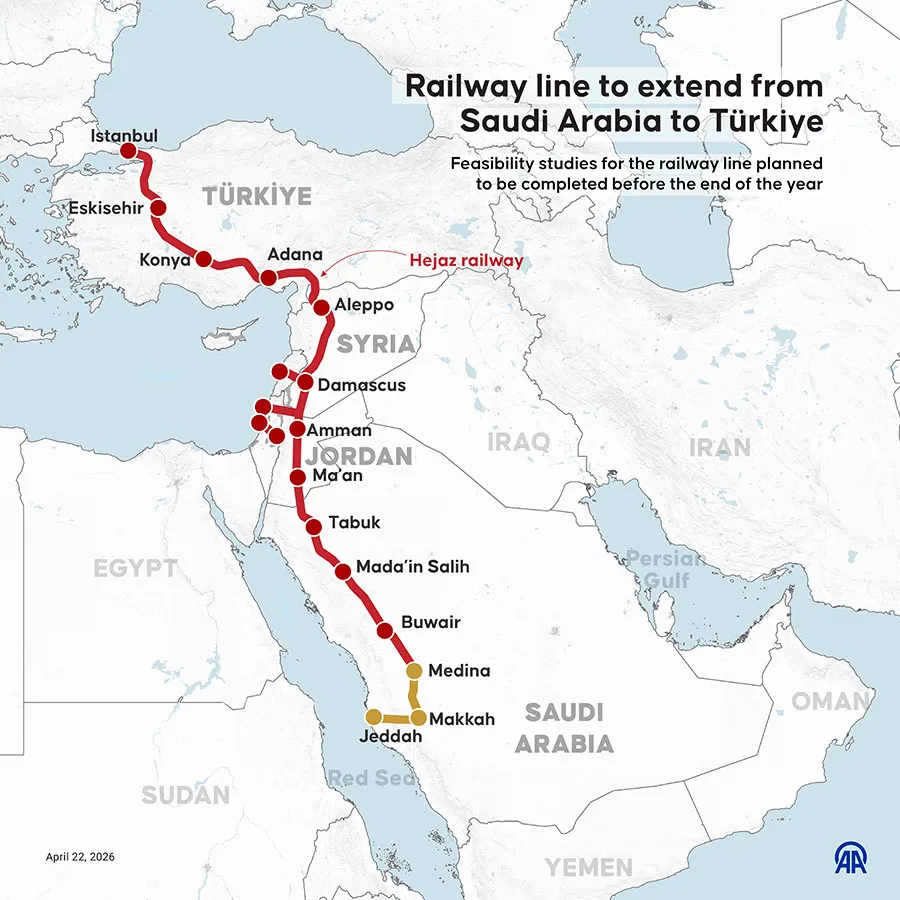 Railway line to extend from Saudi Arabia to Turkiye ANKARA, TURKIYE – APRIL 22: An infographic titled Railway line to extend from Saudi Arabia to Turkiye created in Ankara, Turkiye on April 22, 2026. Feasibility studies for the railway line planned to be completed before the end of the year. Yasin Demirci Anadolu Ankara Türkiye. © IMAGO / Anadolu Agency
The railway initiative builds on the momentum of October 2025, when Türkiye, Syria and Jordan reopened a vital overland transport corridor after a 13-year disruption caused by the Syrian conflict. Following the restoration of uninterrupted road haulage, transit cargo movement through Syrian territory toward Jordan and Gulf markets was formally reinstated. This paved the way for high-level agreements in early 2026 to modernize the rail networks linking Türkiye to Jordan and Saudi Arabia, with feasibility studies for a high-speed link expected by the end of 2026.
The restoration of this route via Syria provides an essential land bridge for Turkish exports heading to the Gulf and North Africa. Since the closure of the Bab al-Hawa border during the height of the Syrian civil war, Turkish logistics firms were forced to rely on expensive and time-consuming Ro-Ro (roll-on/roll-off) sea routes through the Suez Canal. By restoring the overland route, transit times and costs are projected to drop significantly. The Turkish International Transporters Association (UND) noted that the first convoys successfully transiting Syria in late 2025 signaled a return to pre-war transit norms, allowing cargo to move from the Turkish border at Yayladağı through to the Jordanian border in a fraction of the time required by sea.
Parallel to the highway reopening is the more ambitious “Modern Hejaz” railway project. Saudi Transport Minister Saleh Al-Jasser confirmed in April 2026 that technical studies are nearing completion for a railway that would theoretically allow passengers and cargo to travel from Istanbul to the holy cities of Medina and Mecca. This corridor is designed to integrate with Saudi Arabia’s “Vision 2030” and Türkiye’s “Development Road” project, which seeks to connect the Persian Gulf to Europe. By linking these various multinational projects, the regional actors are creating a network that reduces reliance on the Red Sea, which has faced persistent security threats and volatile shipping costs.
Beyond the logistical benefits, the initiative provides a framework for mutual gain from a strategic perspective. Ankara’s push for these corridor s serves a dual purpose: economic revitalization and the formalization of regional alliances. While the primary driver is the movement of goods, the timing of these agreements -occurring alongside a cooling of tensions between Ankara and Damascus- suggests a desire to create regional stability. By embedding Syria into a vital trade route between Türkiye and the Gulf, Ankara incites Damascus to maintain a level of security and cooperation that was absent for over a decade. Moreover, a rail connection extending south through Syria and Jordan could strengthen Türkiye’s position as a transit hub between Europe, the Levant and Gulf markets.


Jordan also benefits from becoming a transit center between the Gulf and the Mediterranean. By positioning itself as the primary overland gateway for Saudi goods heading toward Europe, Amman is effectively insulating its economy against maritime volatility in the Red Sea and the Persian Gulf.
For Syria, the potential gains are even more significant. Years of war devastated much of the country’s infrastructure, including railways, roads and industrial zones. Transit revenues and reconstruction-linked trade routes could provide much needed economic activity as the country seeks to rebuild regional commercial ties.
Saudi Arabia’s interest reflects its broader infrastructure strategy under Vision 2030. Riyadh is investing heavily in logistics, rail transport and industrial connectivity as it attempts to diversify its economy beyond oil revenues. A future railway connection through Jordan and Syria toward Türkiye would create another commercial corridor linking Gulf producers to European markets.
The development of this North-South axis serves as a direct geopolitical counterweight to Israel, fueled by a sharp deterioration in bilateral relations following the war in Gaza. The revival of the historical Hejaz Railway route has triggered broader discussions about whether Türkiye is attempting to construct a regional alignment designed to diminish Israeli influence.
By expanding political coordination with Arab states over the Palestinian issue, Ankara is now effectively offering a land-based alternative to the US-backed India-Middle East-Europe Economic Corridor (IMEC). That project -which intended to link India to the Mediterranean via the Israeli port of Haifa- stalled following the events of February 28, with the US-Israeli launch of Operation Epic Fury and the subsequent closure of the Strait of Hormuz exposed the route’s maritime vulnerabilities. In its wake, the Turkish-led rail and road initiatives provide a competing framework that keeps the flow of goods within a bloc of Muslim-majority states, bypassing Israeli infrastructure entirely.
Although this project does not necessarily imply a hostile alliance against Israel, it is a clear strategic move by President Recep Tayyip Erdoğan to designate Türkiye as the central hub for East-West trade. By consolidating a transit bloc with Jordan, Syria and Saudi Arabia, Türkiye secures its influence in the Arab world and reduces the leverage of alternative routes that would favor Israeli economic integration. The railway, once a symbol of Ottoman unity, is being repurposed as a 21st-century tool for regional leadership, where economic interests shape political alignments.
As the feasibility studies conclude in late 2026, the success of the project will depend on the continued stabilization of Syria and the ability of the four countries to secure financing for the massive infrastructure upgrades. For now, the roar of engines across the Syrian steppe and the planned tracks heading south toward the Hejaz represent a giant step towards a more integrated peaceful, land-linked Middle East, free of US and Israeli influence.