
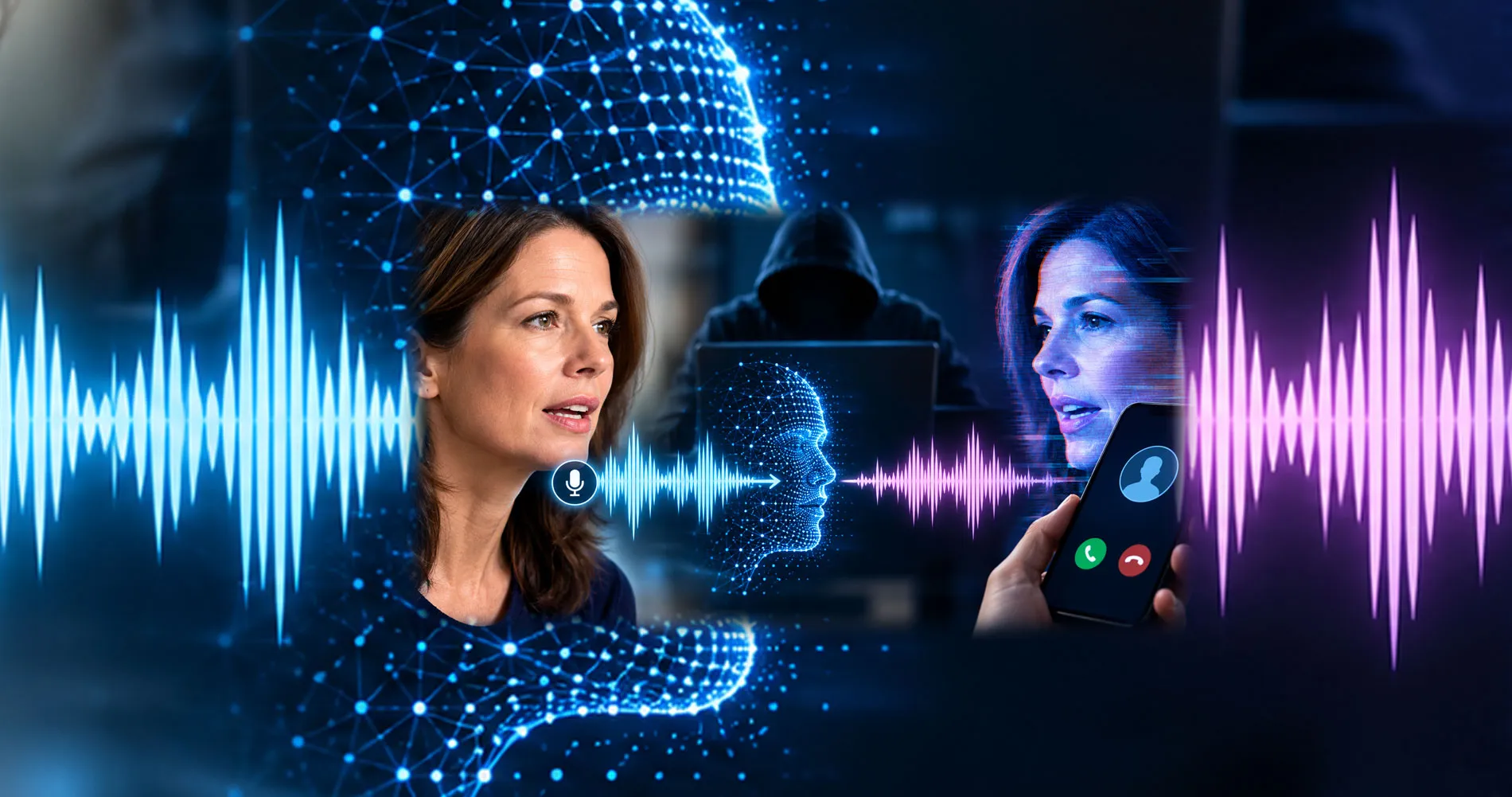
What if someone could make you say something you never said, in a voice that sounds exactly like yours? That is no longer a hypothetical question. Artificial intelligence can now create increasingly convincing digital replicas of human voices, raising questions about fraud, employment, reputation and, most fundamentally, who controls a person’s identity. A recent BBC report highlighted the case of Bristol voice-over artist Faye Dicker, who discovered that her voice had been cloned and sold online without her consent. For professional voice artists, this is not simply a technological curiosity. It is a question of livelihood. A US federal regulator is not merely warning that synthetic voices could be misused; it is actively encouraging and funding attempts to address the problem.
David Deegan
21 October 2026
Adam Woodroffe, director of Practive, a UK leadership consultancy specializing in experiential learning that involves actor-facilitators, shared the concerns of several of his Associates who also worked as voice artists. One said he had been offered USD 30 000 four years ago to have his voice cloned and more recently a separate offer of USD15 000. He rejected both offers, despite there being no apparent contractual restriction on his continuing to work as a voice artist.
His concern was that a cloned version of his voice could compete with his own work. If a client can buy a synthetic version of a recognizable voice and use it repeatedly, he argued, the economic incentive to employ the human performer could diminish.
His concern is not simply theoretical. The US Federal Trade Commission (FTC) identifies voice cloning as a potential threat to the livelihoods of creative professionals, including voice artists. They deemed it a consumer-protection problem serious enough to warrant a dedicated competition, the “Voice Cloning Challenge” in 2024 aimed at finding solutions. The UK government’s March 2026 report on copyright and AI likewise warns that digital replicas can undermine contractual arrangements, compensation and livelihoods.
But the Practive voice artists are worried about something deeper than employment. They are concerned about control. “I want autonomy,” one said. He did not want a synthetic version of his voice being used to support political organizations, causes or products with which he had no association or agreement. A second described the “loss of ethical control” as a key argument against licensing a cloned voice.
That concern goes beyond the question of whether AI can imitate a performance. It asks whether a person’s voice should remain connected to that person’s consent.
Academic research suggests that professional voice artists are thinking about precisely these issues. A US study published in October 2025 titled „PRAC³ (Privacy, Reputation, Accountability, Consent, Credit, Compensation): Voice Actors in AI Data-economy” by Tanusree Sharma, Yihao Zhou, and Visar Berisha, identified six interconnected areas of concern: privacy, reputation, accountability, consent, credit and compensation. The researchers also identified potential misuse of cloned voices in political messaging, erotic content, financial fraud, misinformation and impersonation.
The implications therefore extend well beyond the recording studio.
The FTC says scammers have used cloned voices to impersonate business executives in order to obtain money or valuable information fraudulently and their 2024 Voice Cloning Challenge sought ideas to protect consumers from the misuse of AI-enabled voice cloning for fraud and other harms. The range of submissions illustrated the scale and complexity of the problem. One sought to use AI to detect AI-generated voices. Another proposed imperceptible distortions to speech recordings to make them harder to clone. A third aimed to authenticate the human origin of a recording at the moment it was created, while another was designed to detect voice clones and audio deepfakes in real time. The FTC said the competition demonstrated the potential for technology to mitigate the risks of voice cloning, but also made clear that there is no single solution.
At the same time, the agency acknowledges that voice cloning can have legitimate benefits, including helping people with impaired speech communicate using a version of their own voice. The technology, therefore, is not inherently sinister. The problem is what happens when the ability to reproduce a voice is separated from the consent of the person whose voice it is.
One Practive Associate remains hopeful that there will continue to be a place for real human voices. AI, he argues, may increasingly dominate “functional” voice work, short pieces, advertisements, corporate videos and similar material, but human performance could retain an advantage in long-form work such as audiobooks, drama and multi-voice productions. “People are quirky, and unpredictable, and imperfect,” he said. Those qualities, in his view, make an actual voice feel “human and alive”.
It is impossible to establish whether AI will ultimately convincingly reproduce those qualities, but the concern about authenticity is increasingly difficult to dismiss.
There is also another, darker dimension. PRAC³ research identifies erotic repurposing as one potential risk of voice cloning, while the UK government’s report documents wider harms from non-consensual synthetic replicas, including intimate-image abuse.
The problem is that the law has not necessarily evolved at the same speed as the technology.


In June 2026 voice artist Anne Dicker told the BBC that her voice had been downloaded more than 900 times from US-based AI company Fish Audio. “I have no idea who has used my voice, how they have used it and what they have recorded me saying,” she said. The BBC report cited media lawyer Dr Mathilde Pavis’s view that UK legislation is a “patchwork” of protections including copyright, data protection and trademark law, rather than a coherent right over an individual’s likeness.
The UK government’s own March 2026 report reaches a similar conclusion, acknowledging that existing legal protections “do not cover all situations” in which a digital replica is created without consent. It says AI makes it easier to create convincing replicas of people’s voices and faces, and notes the potential for reputational harm, deception, criminal activity and damage to livelihoods.
The government is now considering whether stronger protection is needed, including the possible creation of a new digital-replica or “personality” right. Dr Pavis told the BBC that other countries have developed stronger protections for aspects of personal identity. But the precise legal models differ, and there is no simple international template that the UK could simply adopt.
For the Practive voice artists however, the principle is simpler. One said he had been advised by colleagues to accept money offered for his voice because, if he did not, someone might eventually clone it without his permission and he would receive nothing. He admitted the argument was persuasive, but he preferred to retain control rather than contribute to what he saw as a threat to the profession as a whole.
The question of whether AI will replace large numbers of human voice artists remains speculative, but a voice that once required a human being to produce, can increasingly be reproduced without that person being present.
The technology may ultimately prove beneficial in ways we cannot yet predict. It may create new creative opportunities, improve accessibility and help people who have lost the ability to speak. But it also creates a new category of risk: a person’s voice can potentially be separated from their consent, their livelihood and their identity.
The question is therefore not simply whether AI can sound sufficiently human. It is whether a human being should retain the right to decide what their voice says, where it is heard and who profits from it.