
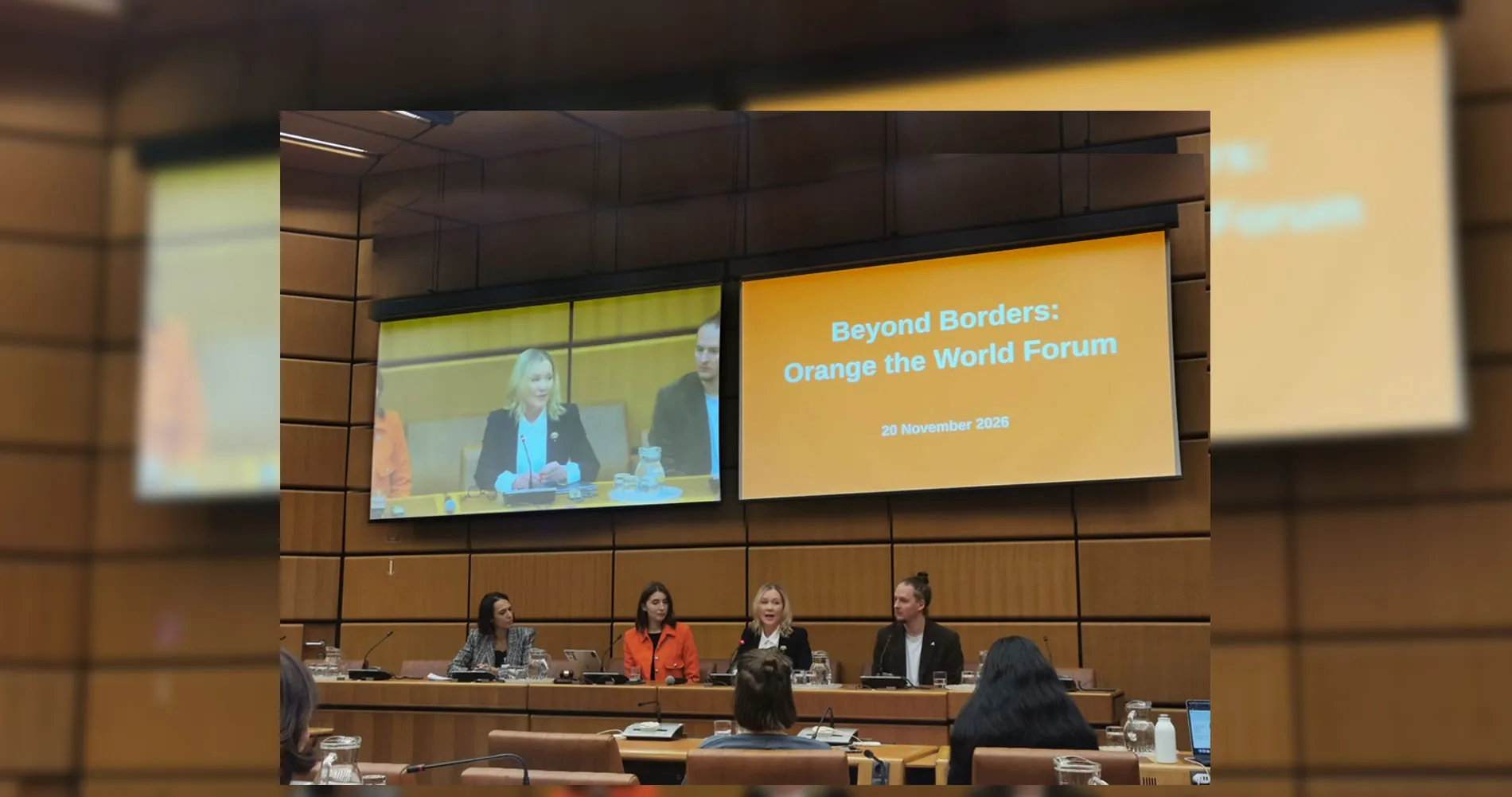
A UN conference took place in Vienna in preparation for the International Day for the Elimination of Violence against Women on 25 November 2026. This UN Conference, „Beyond Borders: Orange the World Forum 2026“, brought together international experts, media, educators and the public to highlight the grave issue of online violence against women and girls. Held at the VIC in Vienna, such fora are important to give those a voice who are too weak to fight for these rights themselves. These are human rights and as such concern us all. No one should look away and everyone is affected.
Diana Mautner Markhof
23 November 2026
In connection with the annual „International Day for the Elimination of Violence against Women“ on 25 November, the UN in Vienna hosted the third international conference to combat online violence against women titled „Beyond Borders: Orange the World Forum 2026“. The subtitle „From Online Harm to Real-World Violence: Building a „Whole-of-Society Response“ sums up the aims of the one-day forum. Held at the Vienna International Center (VIC) on 20 November 2026, the Orange the World Forum 2026 was organized in cooperation with UNIS (United Nations Information Service), INTERPOL, the Embassies of Sweden, Canada, Germany, The Netherlands and Switzerland.
Experts from around the globe came together to discuss the issue of online violence against women and girls and what still needs to be done to stop the criminals who hide behind AI, legal loopholes and the anonymity of the internet. Why organge? It is the color the UN chose to represent the women and girls affected by online violence.
Opening statements by Monica Juma, Director-General of the United Nations Office at Vienna (UNOV) and Executive Director of the United Nations Office on Drugs and Crime (UNODC) and by the current Ambassador of Sweden to Austria, Annika Ben David, were followed by a keynote speech by Jenny-Kerstin Bauer from DFMB (Dachverband Frauen und Mädchenberatung – Umbrella Organisation of Austrian Counseling Centers for Women and Girls). A panel of experts, Cristiana Nador, from the Cybercrime Division of INTERPOL in Singapore, Wendy O’Brien, United Nations Office on Drugs and Crime (UNODC); and, a representative from an NGO, Simon Březina, rounded off the conference which was followed by a brief Q & A session.
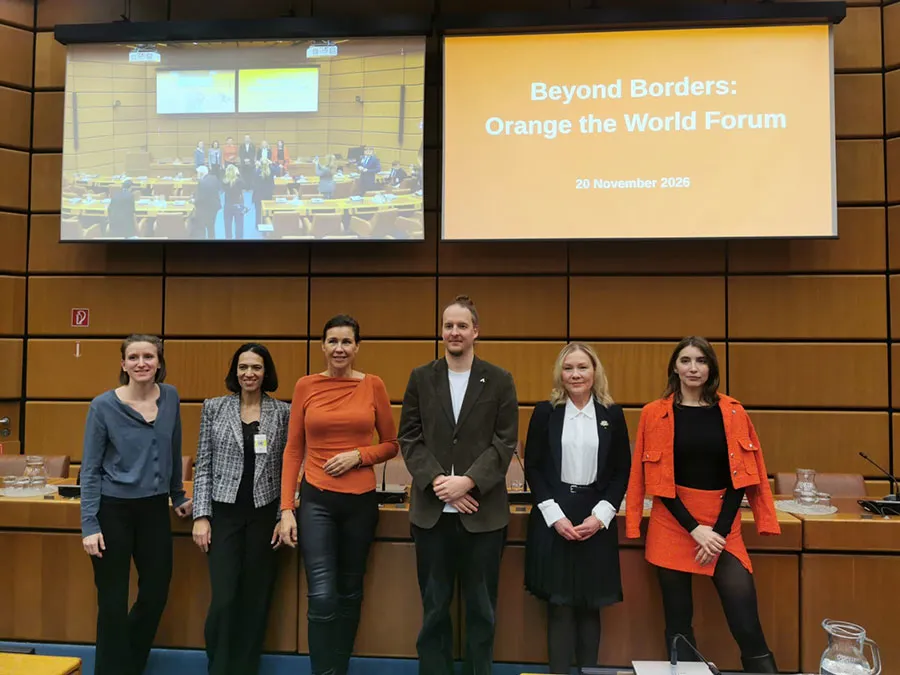 Jenny-Kerstin Bauer, Moderator, Swedish Ambassador in Austria Annika Ben David, Simon Brezina, Wendy O’Brien, Cristiana Nador (from left to right )
The alarming facts speak for themselves: one in ten women have experienced Technology-Facilitated Violence (TFV); about 70% of women have also fallen victim to physical or sexual abuse by a current or former partner; 38% of women according to the presented survey said they had personally experienced online violence; in Austria 32% of women are affected by TFV; and, 51% of girls aged 11 to 17 have experienced online sexual harassment at least once. Worldwide, 1/3 of women report having experienced some form of online sexual harassment and, shockingly, 18 billion girls have no protection against digital violence.
TFV includes digital stalking, sexualized image-based violence, online harassment, identity abuse, hate speech and online sexism. Nudify apps make it easy to sexualize innocent content and initimidate women and girls. Especially in conservative societies, the victims often will do anything to stop such sexually explicit AI creations from being shared among family, friends and employers.
Director General Juma stated what is needed: an „all-of-society approach“ including legislators, law enforcement, Big Tech, educators and the media, all of which must work together to prevent these crimes, prosecute the criminals and protect those who have fallen victim.
Although international agreements are only part of the solution, they are essential. The United Nations Convention against Cybercrime (also known as the Hanoi Convention) is the first comprehensive global treaty on cybercrime, which was adopted by the UN General Assembly on 24 December 2024. It opened for signature in Hanoi in October 2025, and remains open at UN Headquarters in New York until 31 December 2026. According to the United Nations Treaty Collection (as of 19 November 2026), the treaty has 96 signatories and 3 parties (ratifications), and has not yet entered into force. It takes effect 90 days after 40 ratifications.
Under Norway‘s lead The United Nations General Assembly’s Third Committee adopted resolution A/C.3/81/L.36/Rev.1 on 17 November 2026, during the 81st session of the United Nations General Assembly. 167 nations voted in favor, while 4 nations voted against it (Argentina, Belarus, Israel and the US) and 8 nations abstained (China, North Korea, Egypt, Mauritania, Nicaragua, Russia, Saudi Arabia and Uganda). The resolution strengthened protections for human rights defenders against unlawful surveillance, technology-facilitated violence and repression across borders, while calling for greater accountability by states and technology companies.


Contrary to popular myth, the prepetrators of these online crimes are not only men. INTERPOL analyst Cristiana Nador brought case studies showing that the range of perpetrators include women, men and criminial organizations. The victims often come from racially diverse backgrounds and low socio-economic standing.
TFV is a human rights issue and as such concerns everyone. It is not only a problem of women, as Simon Březina from White Ribbon Austria remarked. Society needs to change its attitudes and take responsibility. Men must also be part of the discussion. Big Tech needs to put in more protections and must work together with law enforcement to find the perpetrators of these crimes. As Wendy O’Brien from UNODC put it, „we must stop using weasel words“. Big Tech, politicians, regulators and legislators often use these words to insist that all is well since „guardrails“ are installed, policies are „alligned“ and there is always a „human in the loop“. Empty words that show that for many the system „is actually working just perfectly“, meaning it is allowing many to make big money off of these algorithms. All one needs are enough clicks, followers and likes.
Blaming the algorithm is only part of the story. As many users of social media might have experienced, once you watch a certain type of video the algorithm will automatically direct you to more and more extreme forms of similar content. Thus begins, for many victims and perpetrators, the slow road down the rabbit hole. Another major issue is how Big Tech makes it much too easy to find and install spyware, which is nothing short of „controlware“ when used by perpetrators of onlince violence against women and girls.
TFV is experienced by 1 in 3 women in their lifetime and, as one knows, the internet exacerbates inqualities. Violence spreads quickly, fake news is disseminated with ease and social media platforms do mostly nothing to stop this. But there are models on how this vicous cycle could end: Pakistan for instance has created a Digital Rights Foundation named „Hamara Internet“ to provide online safety workshops for women and girls which are free and confidential. The foundation also offers free legal, digital and psychological support. Australia has installed an eSafety Commissioner to offer information and support for people affected by online abuse, assisting in the removal of harmful content, which includes intimate images shared without consent. Finally in the US, the Cornell Tech Clinic to End Tech Abuse offers a model of how IT support can be provided to survivors of intimate-partner violence with device and account security checks, risk assessment and personal safety plans.
The organizers then invited the public to the fifth Orange Run to bring awareness to the issue. This conference and the run are important reminders that each person can play a part in this task and call on leaders and lawmakers, Big Tech, educators and media to fix the problem, protect the victims and educate the public.