
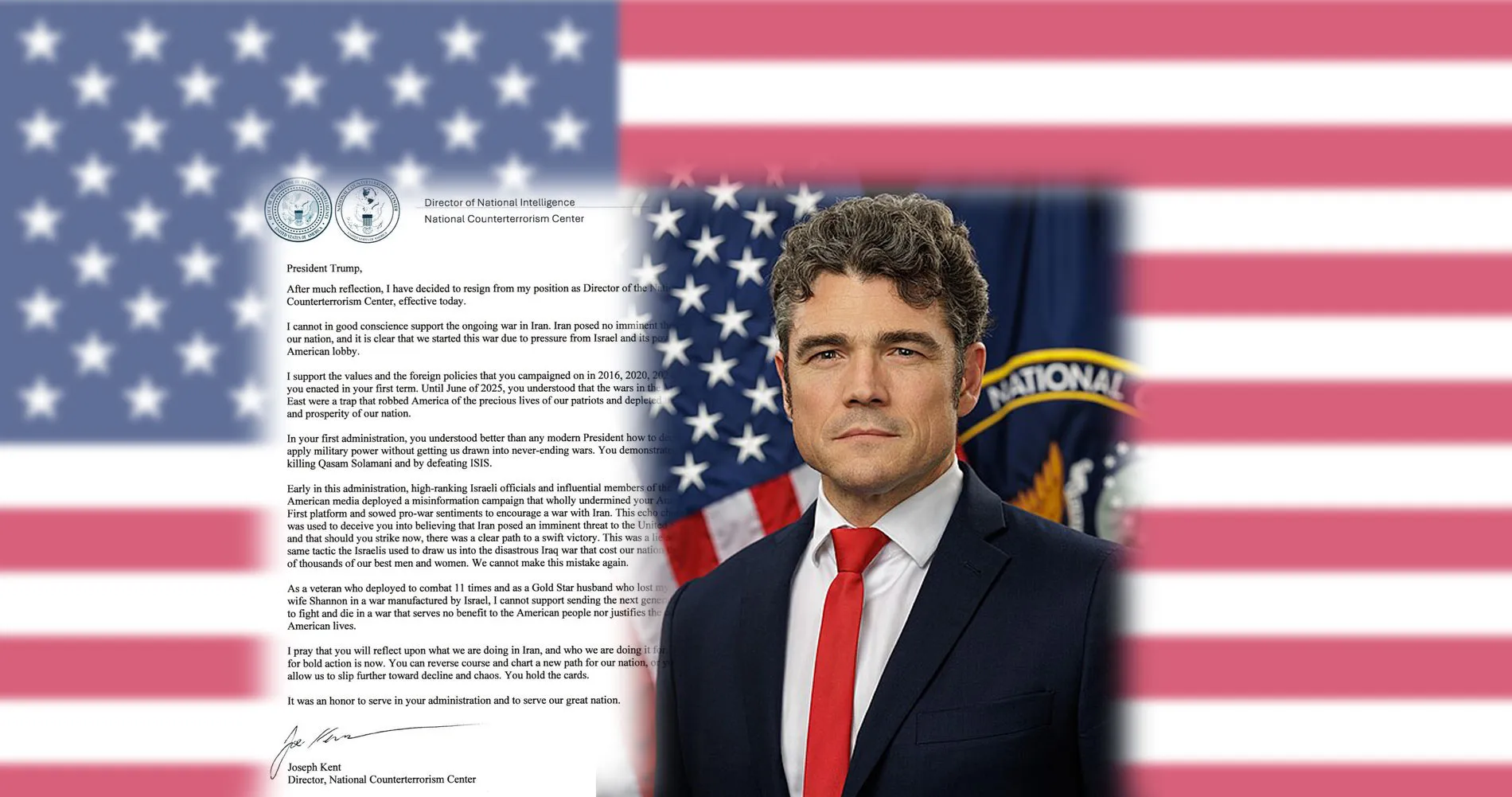
The hasty resignation at the heart of America’s security apparatus raises serious questions about whose war is the US really fighting? Joe Kent walked away from one of the country’s most powerful intelligence roles because he knows the answer. The US is fighting Israel’s war. In the US, there is a growing majority against US unconditional support for Israel. A majority of Americans oppose the war on Iran.
Alexandra Dubsky
20 April 2026
French version
Joe Kent stepped down on 17 March 2026 from his position as head of the US Counterterrorism organization, mainly because of his opposition to the US-Israeli war against Iran. He has repeatedly argued that Iran did not pose a direct threat to the US. Kent could not back a policy that might risk dragging the US into another unnecessary, endless, and expensive war in the Middle East. This was also one of Donald Trump’s core promises during his election campaign.
Another key aspect of Kent’s resignation was his stand on Israel’s influence over the American President. In his resignation letter, he stated that the United States has been dragged into the conflict with Iran mainly due to political pressure from Israel and its influential Israel lobby in the US.
Kent stated that important Israeli officials who pushed for military action had for decades supported a compelling narrative portraying Iran as an imminent threat. He also suggested that misinformation had played a key role in convincing decision-makers in Washington to support the war.
According to Kent, this included intelligence evaluations that may have overplayed the imminence of Iran’s threat, selective use of proof to stress worst-case scenarios, and public messaging that framed the status quo as highly critical. He emphasized that differing analyses within the intelligence community was not given equal weight, drawing a biased picture that made a military strike seem the only possible option.
His allegations confirm past controversies regarding US foreign policymaking involving dubious or incomplete intelligence supposedly leading to important military decisions. Kent’s observations led to further heated discussion over how intelligence is interpreted and executed at the highest levels of US government.
More and more voices are agreeing with Kent’s stance regarding Israel, from progressive politicians to “America First” conservatives. The main claim among these critics is that Israel and its political elite, mainly Prime Minister Benjamin Netanyahu, have pulled the US into the war to serve Israeli rather than American interests.
US Democrat Senator Bernie Sanders is one of the most vocal critics of the US-Israel war, stating that “Netanyahu wanted war with Iran. Trump just gave it to him.” He told US media that American foreign policy must be determined by the American people and their interests, not by a “right-wing extremist Netanyahu government”.
Former Trump supporter and media personality Tucker Carlson has also criticized the current administration. Carlson has publicly split with the government and Donald Trump, suggesting that the US went to war “at the behest and then the demand of Israel”. He has recently requested that the US government completely detach its foreign policy from Israel and halt all military support for Israel immediately.


US Republican Representative Thomas Massie, another leading politician in the “America First” wing, who opposes the war on Iran, linked the conflict to a “disloyalty” regarding US national priorities, claiming that the only winners of this war were US defense contractors.
Overall, only 34% of American strongly or somewhat support the war on Iran. Recent polls show that while most Republicans support the military action (67%), the majority of Americans (approximately 53%) oppose the intervention in Iran, with 22% of Democrats specifically naming Israeli interests as the primary pull-factor behind the war. An overwhelming majority of Democrats 84% oppose the war, with only 9% in favor of it.
Joe Kent served in several elite army units and was deployed multiple times, including to Iraq. After finishing his military service, he joined the CIA as a paramilitary officer, which gave him direct experience in counterterrorism operations.
His personal life played a big role in forming his opinions. In 2019, his wife was killed in Syria during a military operation against IS fighters. The loss had a deep effect on Kent and increasingly shaped his later doubts towards lengthy military engagements abroad.
Kent eventually became interested in politics and a supporter of President Trump. He was appointed head of the National Counterterrorism Center (NCTC) in 2025 giving him a key role in US counterterrorism policy.