
West Africa’s shrinking fish catches are too easily blamed on foreign fleets, and on China above all, but the evidence points to a more uncomfortable truth. From Sierra Leone to Senegal the same crisis repeats itself because weak surveillance, opaque licensing and feeble enforcement make illegal fishing profitable in the first place. Until governance failure is confronted, local communities continue to suffer from the illicit activities of Chinese, Turkish, Korean and other distant-water fishing fleets.
Michael Asiedu
25 November 2026
West Africa should be one of the world’s great maritime success stories. Its Atlantic coastline stretches from Mauritania to Nigeria, embracing some of the world’s most productive fishing grounds. Fish is not simply another commodity here. It is food, income and culture. More than six million people across the region depend directly or indirectly on fisheries for their livelihoods, while millions more rely on fish as their cheapest and most accessible source of animal protein. Governments increasingly speak of harnessing the “blue economy” to drive economic transformation. On paper, the future appears promising.
Yet for many coastal communities, the sea is becoming harder to live from. From Sierra Leone’s Sherbro Island to Ghana’s Elmina, Senegal’s Joal-Fadiouth and The Gambia’s Gunjur, fishermen tell remarkably similar stories. They leave earlier, travel farther and return with steadily smaller catches. Nets are damaged. Fuel costs are rising. Younger fishermen increasingly question whether there is still a future at sea. The geography changes along West Africa’s coastline, but the complaints barely do.
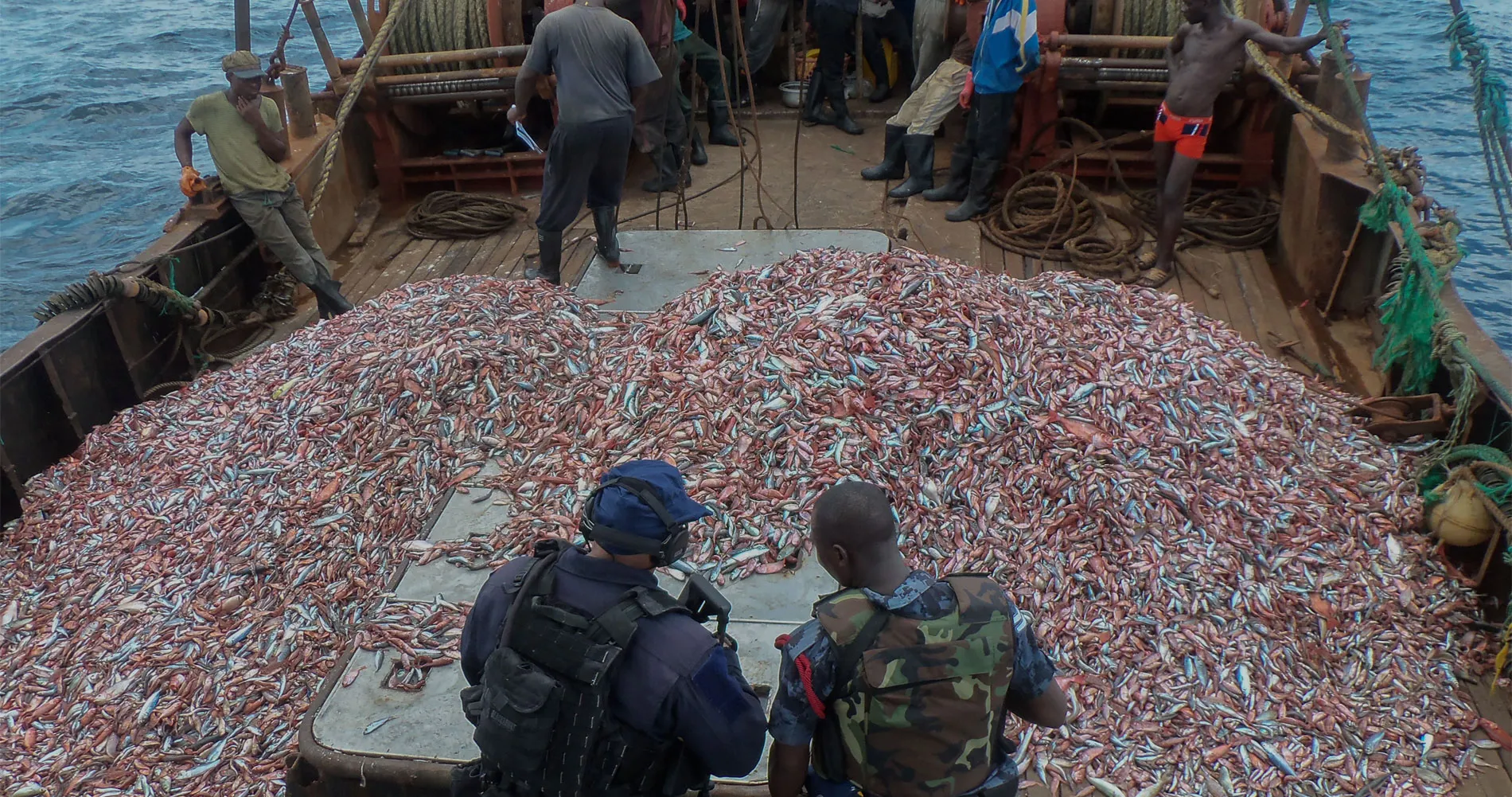
A recent BBC report from Sherbro Island brought this reality into sharp focus. Fishermen accused industrial trawlers of entering Sierra Leone’s protected inshore exclusion zone under the cover of darkness, damaging nets and competing directly with artisanal boats. Their union estimates that catches have declined by around 40 per cent in recent years.
Government officials point to vessel-monitoring systems, onboard observers and tighter regulations as evidence that enforcement has improved. Yet for fishing communities, the real measure of success is simpler: whether tomorrow’s catch is enough to support today’s family.
Sherbro Island is not an exception. In Ghana, the crisis has become synonymous with one word: saiko. The practice, officially illegal, involves industrial trawlers catching small pelagic species reserved for artisanal fishers before transferring them at sea to specially adapted canoes that sell the fish in local markets. According to the Environmental Justice Foundation, saiko landings reached about 100,000 tonnes in 2017, worth as much as US$65 million. More striking still, just 76 industrial trawlers landed almost as much fish as more than 12,000 artisanal canoes employing around 100,000 fishers. Those numbers reveal more than unequal fishing capacity. They expose an increasingly unequal distribution of opportunity.
The effects are felt far beyond the men who go to sea. Across Ghana and much of West Africa, women dominate fish smoking, processing and trading. When canoes return with fewer fish, processors compete over shrinking supplies, market prices rise and household incomes fall. Sardinella, bonga and anchovies—often described as the region’s “people’s fish” because they provide affordable protein to millions—become scarcer and more expensive. An empty canoe means fewer baskets at the landing beach, fewer customers in local markets and fewer affordable meals on family tables.
The same pattern extends beyond Ghana. In Senegal, where fishing has long been central to coastal economies, more than half of fish stocks are now either fully exploited or collapsing. Fishing crews from towns such as Joal-Fadiouth and Mbour spend longer at sea for diminishing returns, while some young men have abandoned the profession altogether. Increasingly, the pirogues that once carried fishermen to productive fishing grounds are also carrying migrants towards Spain’s Canary Islands. The sea that once offered livelihoods has become, for some, a route of escape.


In neighbouring The Gambia, artisanal fishermen continue to complain that industrial vessels enter the nine-nautical-mile zone reserved for local fishing. Meanwhile, the rapid growth of fishmeal factories in Mauritania, Senegal and The Gambia has created another source of pressure on small pelagic stocks. Pelagic fish stocks live and feed near the surface or in mid-water rather than on or near the ocean floor.
Greenpeace estimates that dozens of factories now process hundreds of thousands of tonnes of fish each year into meal and oil destined largely for overseas aquaculture and livestock industries. Fish that once fed coastal communities increasingly feed global supply chains.
Viewed separately, these appear to be national fisheries disputes. Viewed together, they reveal something far more significant.
West Africa is not experiencing four distinct fishing crises; it is in the midst of one supraregional crisis with local variations. The same symptoms—declining catches, damaged gear, shrinking incomes and frustrated fishing communities—appear across countries with different governments, different fisheries laws and different political systems. That should force us to ask a more important question. Why does the same story keep repeating itself? The obvious answer is China.
China operates the world’s largest distant-water fishing fleet. Chinese-owned or Chinese-linked companies are prominent in several West African fisheries. Their activities deserve scrutiny, particularly where investigations have documented illegal fishing, hidden ownership structures or incursions into protected waters.
But China alone cannot explain why fishermen from Sierra Leone to Senegal describe almost identical experiences. Spanish, Korean, Turkish and other foreign fleets have also operated across the region. Focusing only on nationality risks overlooking the political conditions that make illegal fishing profitable in the first place. Foreign fleets do not create weak governance. They exploit it.
Illegal fishing flourishes where surveillance is weak, licensing lacks transparency, penalties are too small to deter repeat offenders and institutions lack either the resources or the political backing to enforce the law consistently. Every illegal catch diminishes public confidence in their ability to protect the resources they claim to govern.
To be fair, governments are not standing still. Ghana continues to impose seasonal fishing closures and has strengthened action against saiko. Senegal’s new administration has begun issuing fishing licences and auditing the sector after years of criticism over opaque agreements. Sierra Leone has expanded vessel monitoring, while regional initiatives such as the 2026 Mombasa Declaration seek greater transparency over vessel ownership, licensing and fishing activity. These are encouraging steps, but not the solution.
West African governments increasingly celebrate the blue economy as the next frontier of development, yet many of the communities that have depended on the sea for generations feel increasingly excluded from its benefits. Ports are expanding. Maritime trade is growing. Investment is flowing. Yet the fishermen who first built these coastal economies often return home with less to show for a day’s work.
What would a solution require? 1.) Increase transparency by opening registries and naming who owns and profits from every licensed trawler. This obligation will uncover illegal operators who will no longer be able to hide. 2.) Adapting penalties from fines to forfeiture and licence revocation. 3.) And because a vessel barred from one country’s waters can fish in its neighbor’s the next week, enforcement must be regional, not national. Shared monitoring data and a common blacklist of offenders is necessary for combating illegal fishing.
Ultimately, West Africa’s fisheries crisis is not simply about disappearing fish. It is about who benefits from the region’s marine wealth, who bears the costs of its depletion and whether states can translate ambitious policies into credible governance.
From Sherbro Island to Elmina, from Joal-Fadiouth to Gunjur, empty nets are telling a story that reaches far beyond the shoreline. They remind us that the true measure of the blue economy is not the value of fish exported or the number of ports expanded. It is whether the communities that have lived from the sea for generations can still build a future upon it.