

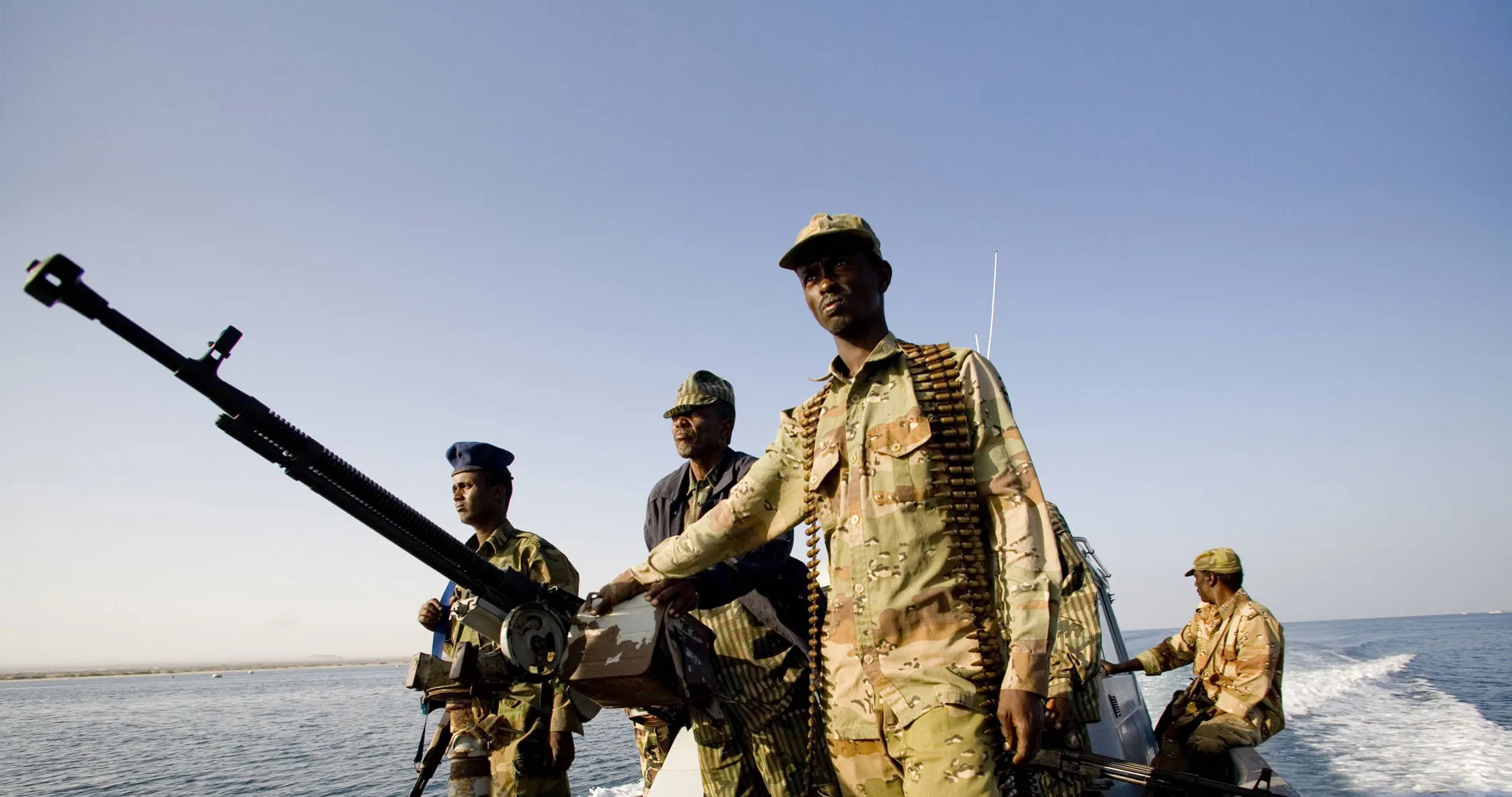
Piracy is quietly resurfacing off Somalia’s coast as armed groups test gaps in regional security. Recent attacks, economic pressures and local maritime vulnerabilities are creating renewed risks for coastal communities, global shipping and a region already under strain.
Michael Asiedu
26 January 2026
German version
Piracy in the western Indian Ocean is again becoming a concern. After more than a decade of relative calm, recent incidents reported by international monitors and major news outlets show that Somali waters, once among the most dangerous in the world, are facing renewed instability. Maritime security advisories issued in recent months, along with rising concern among Somali fishing communities, point to a quiet but notable resurgence. Activity remains far below the levels recorded between 2008 and 2012, but it has returned to the radar of shipowners, insurers and naval forces.
Several credible reports confirm this shift. In November, Reuters reported that an EU warship secured the crew of the Malta-flagged tanker Hellas Aphrodite after pirate assailants opened fire on the vessel off the Somali coast while it was sailing from India to South Africa. Around the same time, the Financial Times noted that pirates boarded a commercial vessel near Eyl, a coastal town in Puntland in northeastern Somalia that served as a major hub of pirate activity during the 2008 to 2012 surge, marking the first such incident in 18 months. The International Maritime Bureau (IMB) has also logged recent attempted boardings and armed robberies in Somali waters. The pattern emerging from these incidents suggests that groups, with some operational capacity, are probing lapses in maritime security coverage.
This renewed activity is unfolding in a region already under strain. Naval priorities in the Red Sea and Gulf of Aden have shifted because of the conflict in Yemen, forcing international forces to divide their attention between counter-piracy duties and monitoring missile and drone threats linked to that conflict. Thinner or less predictable patrols create openings for opportunistic actors. The scale of the western Indian Ocean makes continuous surveillance difficult even in stable periods, and current deployments are spread across multiple emerging risks.
Governance challenges inside Somalia reinforce these vulnerabilities. Although the country has made political progress, maritime enforcement capacity remains limited. Puntland, historically the centre of Somali pirate activity, continues to face shortages in coastal patrol assets and maritime law enforcement. Weak state presence along sections of the coast allows small armed groups and smugglers to operate with relative freedom. This does not automatically translate into organised piracy but it creates conditions in which criminal activity at sea can reappear.
Local economic pressures further complicate the picture. Somali fishing leaders have long raised concerns about illegal, unreported and unregulated (IUU) fishing by foreign vessels, warning that it undermines livelihoods and heightens insecurity. Interviews in regional media reflect these frustrations. Coastal communities feel squeezed by declining fish stocks, foreign competition and limited government protection. Although IUU fishing is not a direct cause of piracy, it deepens economic vulnerability, making recruitment into maritime crime more likely, especially among young men with few alternatives.
Recent incidents suggest that active groups are smaller and less organized than those of a decade ago. IMB logs and EU NAVFOR advisories indicate that most attacks involve small skiffs attempting to board vessels using light weapons. Several attempts were disrupted by evasive manoeuvres or naval intervention. These operations appear opportunistic rather than the coordinated hijackings of the past, when pirates used large mother ships to strike far into the Indian Ocean. Yet analysts warn that persistent low-level activity can escalate quickly if left unchecked.
The financing behind these recent attacks remains unclear. During the height of Somali piracy, UN investigations documented sophisticated networks of ransom financiers, negotiators and logistical suppliers. Today, no such networks have been publicly identified by the IMB, EU NAVFOR or the UN Panel of Experts on Somalia. Current evidence points instead to small, locally embedded groups with limited capacity. The widespread availability of small arms inside Somalia lowers barriers to entry for such actors, but there is no verified public evidence linking current incidents to major external sponsors. Broader claims of organised financing pipelines therefore remain unproven.
International naval forces continue to play a crucial deterrent role. The EU’s Operation Atalanta maintains patrols in the Gulf of Aden and the western Indian Ocean, and Japan, the United States, the United Kingdom, India and several Gulf states contribute to surveillance and information-sharing. These missions have helped keep large-scale hijackings rare, although officials acknowledge that the area to be covered is vast and resources are limited.


For Somali coastal communities, the consequences are immediate. Fishing is a vital livelihood, and any increase in maritime insecurity threatens already fragile local economies. Community leaders warn that worsening conditions could again push some young men towards criminal networks, a cycle observed during earlier periods of instability.
For global commerce, the stakes extend beyond Somalia. The Gulf of Aden remains one of the world’s busiest shipping corridors, linking Europe, Asia and the Middle East. Even a modest rise in piracy attempts can drive up insurance costs, force ships to reroute at increased costs and disrupt humanitarian deliveries to East Africa.
Avoiding escalation will require attention to both land-based and maritime factors, strengthening Somali maritime governance, improving coastal enforcement, addressing IUU fishing and maintaining a consistent, coordinated naval presence to deter attacks.
Somali piracy has not returned to the scale that once dominated global headlines, but the warning signs are visible. It would be a mistake to assume the threat has disappeared. The quiet return of piracy today could become a louder and more costly challenge tomorrow if the underlying vulnerabilities are not addressed.