
Operation Midas—this fall’s explosive USD 100 million corruption scandal—is not just a domestic crisis; it is colliding with a defining moment in the Ukraine Russian war and its stalled peace negotiations. Zelensky’s closest advisor and alter ego, Andriy Yermak, has resigned because of corruption charges. This has weakened President Zelensky’s government with many questioning whether Zelensky’s government can survive under war conditions and the ever widening web of corruption scandals rocking Ukraine’s political elite.
Frances Mautner Markhof and Meric Sentuna Kalaycioglu
1 December 2025
Chinese version | German version
The resigning of Ukrainian President Volodymyr Zelensky’s chief of staff, Andriy Yermak, because of corruption allegations comes at the most inconvenient time for Zelensky. Yermak was Ukraine’s top negotiator and resigned following an anti-corruption raid on his home. Moreover, Yermak has been Zelensky’s most important adviser throughout Russia’s war and held immense political power. Yermak is a former film producer. Time Magazine listed Yermak as one of the 100 most influential people in the world.
Yermak is Zelensky’s closest confidant and has worked for him on his presidential campaign. Yermak is the main point of contact between Zelensky and President Trump and, according to a 2024 Financial Times article, Yermak often acted with presidential authority. “Among Ukrainians, foreign leaders and diplomats, he is a person of immense and polarizing influence.” He has been accused of eroding democratic checks and balances. The Kyiv Independent reported that officials said Yermak was regarded unfavorably in the US and EU political elites and that in Ukraine his reputation “was even worse”.
Although Yermak has not been formally charged, his proximity both to the businessman Tymur Mindich and to the President bodes ill for Ukraine’s credibility. How long will Zelensky be able to avoid being entangled in the corruption scandal?
The autumn of 2025 has witnessed a high-profile corruption case in Ukraine, involving ministers and close associates of President Volodymyr Zelensky. An estimated USD 100 million in embezzled funds has ignited a fresh wave of political turmoil and public anger. The scandal has quickly become a significant test for the country’s war-time leadership and its ongoing commitment to wipe out systemic graft. Before the bombshell of Yermak’s resignation, multiple senior officials, including Justice Minister German Galushchenko who served as energy minister from 2021 to 2025, and his successor, Energy Minister Svitlana Hrynchuk, have been forced to resign because of their involvement in the corruption net ensnaring the entire Ukrainian government.
Another central figure in this case is the businessman Tymur Mindich, a long-time associate of President Zelensky. Ukrainian investigators accuse Mindich of using his personal connections to extract illicit payments from contractors working with Energoatom, the state-owned main operator of Ukrainian nuclear power plants. The National Anti-Corruption Bureau of Ukraine (NABU) and the Specialized Anti-Corruption Prosecutor’s Office (SAPO) launched the investigation — known publicly as Operation Midas — last year.
Midas has been one of the most high-profile anti-corruption investigations in Ukraine since the beginning of the war in 2022. According to NABU, contractors were pressured into paying 10–15 percent in kickbacks in exchange for state contracts. On 10 November 2025, Mindich reportedly left Ukraine for Israel, and on the same day NABU carried out sweeping raids across more than 70 locations, including Mindich’s residence.
This crisis comes at a critical juncture for Ukraine, which has continuously sought to distinguish its path towards democracy. Despite the ongoing war, the country has been making visible, but slow progress on global graft indices. The 2024 Corruption Perceptions Index by Transparency International still placed Ukraine 105th out of 180 countries. This is a minor improvement to its 2020 ranking of 117.
When in the summer of 2025 Zelensky and Yermak supported legislation to appoint a political prosecutor general for NABU and SAPO, Zelenskyy faced significant protests – called the “Cardboard protests” named after the hand-made posters prepared by the protesters. Hundreds of Ukrainians protested against this legislation that would have effectively curbed the independence of NABU and the SAPO. Following intense domestic pressure and international warnings, President Zelensky signed a new law to restore the agencies’ full autonomy. (cf. iGlobenews article on “Volodymyr Zelensky’s Second Front: Ukraine’s Corruption”, 4 April 2024 https://www.iglobenews.org/volodymyr-zelensky/).


Kyiv’s wish to sustain a credible anti-corruption effort is especially important under the current scrutiny from its Western partners in connection with its ambition to join the European Union. On 13 November, the Hungarian Prime Minister Viktor Orbán posted on social media platform X regarding Ukraine: “This is the chaos into which the Brusselian elite want to pour European taxpayers’ money, where whatever isn’t shot off on the front lines ends up in the pockets of the war mafia. Madness.” This puts additional pressure on Zelensky not only to clean house, but also to be seen doing so transparently and decisively.
It is precisely at this juncture that Kyiv’s position in its existential fight against Russia has become increasingly fragile. Years of warfare have left the country severely dependent on Western aid, struggling with a shortage of soldiers and the massive financial strain of the war while its citizens are suffering from the effects of the war. It has become clear that Ukraine is completely dependent on the sustained flow of military and financial support from its Western supporters, particularly the US.
For a wartime leader already negotiating from a position of dependency, the corruption crisis is a major blow. Public support in and for Ukraine’s war is waning with a majority of Ukrainians in favor of ending the war with Russia. News of massive corruption in the Ukranian government is making it increasingly difficult for EU leaders to show unconditional support for Zelensky’s government.
As Kyiv seeks to negotiate a final deal that fully upholds its sovereignty, the timing of Operation Midas could not be worse. It severely limits Zelensky’s room for opposing US pressure and the proposed US peace deal with Russia, handing a diplomatic advantage to those urging immediate de-escalation and ending the war, even at the cost of significant territorial and other concessions.
Ukraine is increasingly under pressure militarily. The corruption scandal has added even more pressure on Zelensky. Turkish Radio and Television Cooperation (TRT) reported on 28 November 2025 that experts point out that Trump and his allies are concerned that Zelensky himself will be implicated in this web of corruption which would “spark internal fighting between the army and political elites”.
For Ukraine, the best became the enemy of the good, and its options have shrunk accordingly
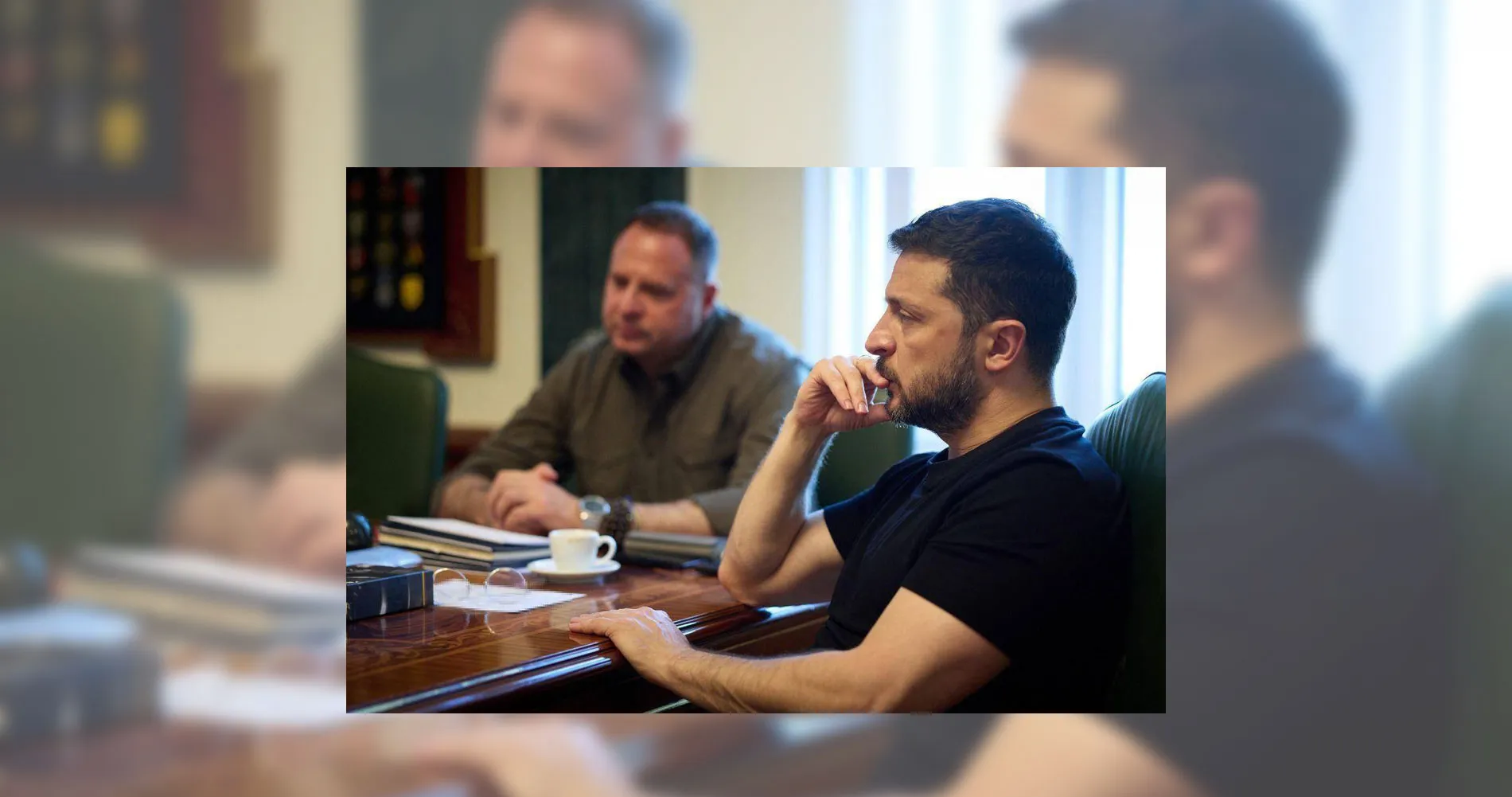
Picture: Ukrainian President Volodymyr Zelensky Kyiv, UKRAINE – 22 JULY 2025: Ukrainian President Volodymyr Zelenskyy holds a meeting with Secretary of the National Security and Defense Council of Ukraine Rustem Umerov and Head of the Office Andriy Yermak to discuss the peace negotiations on 22 July 2025, in Kyiv, Ukraine. Zelensky Offical Telegram Account Anadolu Kyiv Ukraine. ©IMAGO / Anadolu Agency
Other Articles Which Might Interest You
Volodymyr Zelensky’s Second Front: Ukraine’s Corruption