
Long-standing tensions between Israel and Lebanon are entering a brutal new phase, as escalating attacks on civilians raise fears that the situation in Lebanon may soon echo those in Gaza. Israel is attacking Lebanon indiscriminately. Killing almost two thousand civilians cannot be justified by self-defense.
Jessica Hall
13 April 2026
As the United States and Iran prepared to hold talks in Pakistan, Israel continued to bomb Lebanon. On Wednesday, 8 April 2026, Israel killed 357 civilians in a wave of attacks which have been dubbed “Black Wednesday”. The strikes which lasted 10 minutes injured more than 1150 people. Israel struck 100 sites across Beirut, the Beqaa Valley and southern Lebanon, reportedly targeting densely populated areas without prior warning.
Long-standing tensions between Israel and Lebanon are entering a new brutal phase – one marked by more and more targeted attacks on civilians that echo the genocide perpetrated by Israel in Gaza. Since Israel launched its attacks and ground invasion into Lebanon, it has killed 1739 people, including over 130 children and wounded 5873 according to Lebanon’s Health Ministry.
Israel and Lebanon share a long and contentious border, with conflict regularly flaring up between the two countries. The origins of this hostility can be traced to the 1948 Arab-Israeli War, when Lebanon, alongside other regional states, declared war on Israel following its declaration of independence in the territory of Palestine.
Today, the conflict is understood as one between the state of Israel and Hezbollah. Hezbollah is a Lebanese Shia Islamist political and militant organization with significant social influence and military capability. It first emerged in 1982. It has long maintained an anti-Israel, anti-West, and pro-Iranian stance. While its exact capabilities are difficult to quantify, Hezbollah is often considered the central armed actor in Lebanon, with more military assets than the Lebanese Armed Forces.
Hostilities between Hezbollah and Israel escalated since October 2023, when Hezbollah launched rocket strikes on Israel to weaken it during its violent, expansionist campaign in Gaza and the West Bank. Israel responded with drone strikes. Hezbollah is committed to maintaining attacks on Israel as long as the IDF continues its attacks on Palestinians in Gaza and the West Bank.
Lebanese-Israeli hostilities have further intensified in the wake of the US-Israeli war on Iran. Hezbollah, which is supported by Iran, came to Iran’s defense on 2 March 2026. However, Israel has used these attacks to start a war against Lebanon and its population. The scale and intensity of the Israeli attacks have been condemned by many leaders including Chancellor Mertz of Germany, President Sanchez of Spain and France’s President Macron.
In March 2026, Israeli Defense Minister Katz had called for the evacuation of southern Lebanon, a region predominantly home to Shiite Muslim communities, ahead of planned Israeli strikes. Although the laws of war permit the temporary evacuation of civilians preceding planned military operations, the UN immediately raised concerns over potential violations of these same laws, particularly regarding the scale and indiscriminate impact of these attacks on Lebanon’s civilian populations. A concern which has since proven to be justified.
While condemning actions from both sides, the UN warned against the replication of the devastation seen in Gaza within Lebanon.
On 26 March 2026, Netanyahu, alongside his Defense Minister Katz, confirmed plans to expand Israeli operations into southern Lebanon through the creation of what they described as a “buffer zone.” This move entails the seizure and control of sovereign territory, raising serious questions over the principles of territorial integrity long established in international law. The Israeli government justifies the “buffer zone” citing its national security interest and the safety its population.
Since then, repeated calls for peace have been issued by a range of actors, including the UN Secretary-General, the European Union, Heads of State, and prominent figures from the media, entertainment industry and academia. However, in the absence of a concrete ceasefire framework which Israel adheres to, attacks by the IDF have escalated.
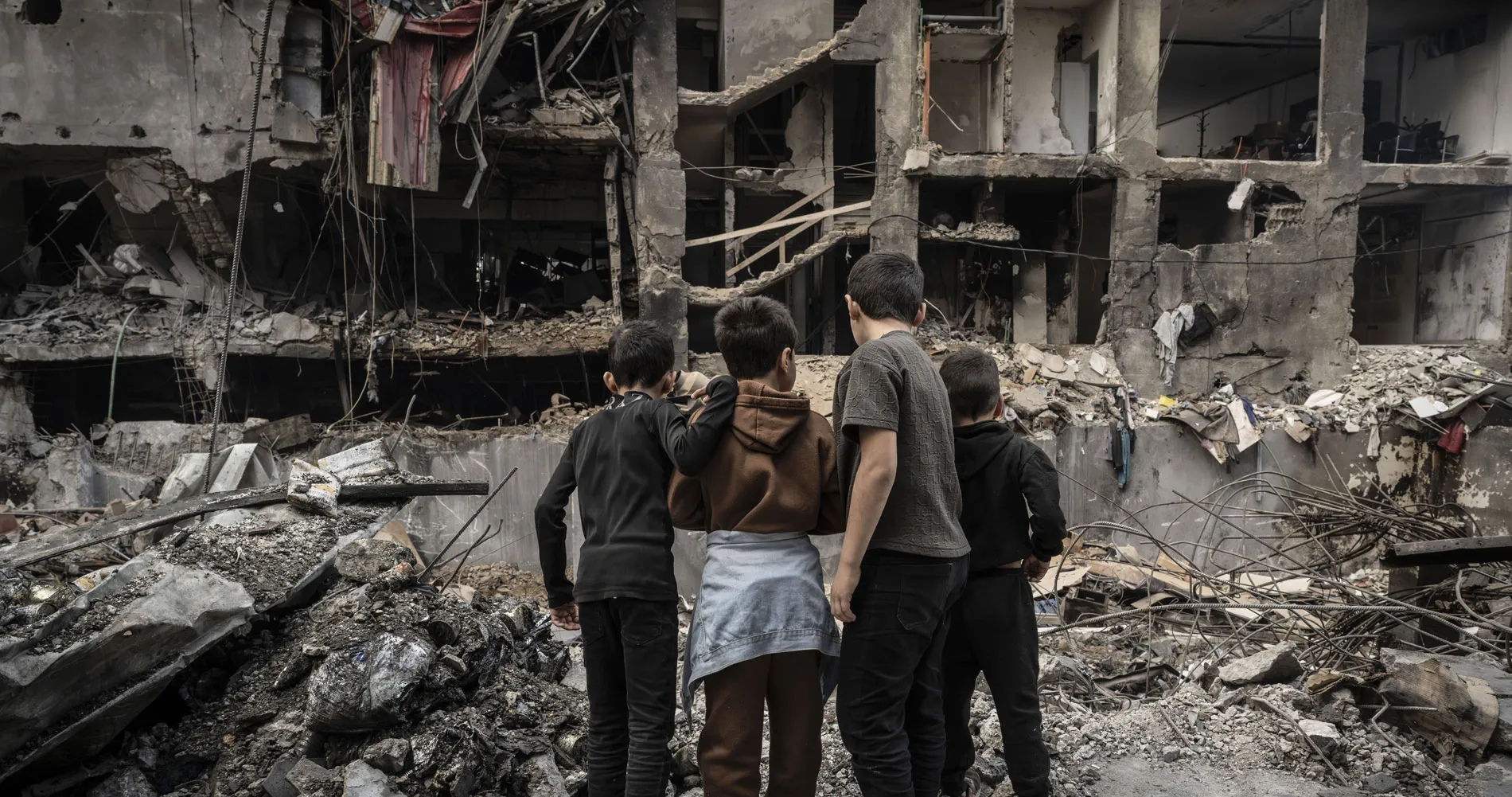
Israel’s conduct in Lebanon now increasingly mirrors patterns seen in Gaza. Israeli airstrikes have targeted homes, local facilities, and critical infrastructure, contributing to large-scale permanent displacement that undermines the laws of war.
Those who remain face a “leave-or-die” threat by the IDF, where civilians are warned of imminent lethal attacks, yet are often left with limited means to escape. A pattern the IDF employed on Gaza.
Specifically, Israel has purposefully destroyed or taken control of bridges and access routes, allowing Israeli soldiers to regulate movement in and out of the region. Some civilians have been denied the ability to leave, even as evacuation is framed as a voluntary choice.
The scale of this displacement is significant. The affected zone spans close to 15 percent of Lebanon’s territory, encompassing over 1000 towns and villages. Recent reports estimate up to 1.2 million people have already been displaced from the region. Forced displacement is also a war crime. Some have fled across borders, others are crouching in overcrowded and under-resourced shelters, and many remain unaccounted for. Under international humanitarian law, particularly the Fourth Geneva Convention and the Rome Statute, the unlawful, coerced removal of civilians from their homes during an armed conflict is defined as a grave breach in both international and non-international conflicts.


The death toll of Black Wednesday includes three Indonesian peacekeepers of the United Nations Interim Force in Lebanon (UNIFIL). Some investigations have concluded that their deaths resulted from Israeli strikes, despite the peacekeepers having communicated their positions to all relevant parties in advance, in line with standard operational procedures. If confirmed, both incidents could constitute serious violations of international humanitarian law.
What is emerging is not a conventional conflict or war, but an offensive war against Lebanon’s civilian population and a rapidly escalating humanitarian crisis in which the rules of international law and the laws of war are blatantly disregarded by Israel.
Israel’s actions can no longer be understood solely as military responses to an immediate threat, carried out in self-defense. Netanyahu’s right-wing Zionist government has openly advocated the expansion of Israeli territory to achieve a Greater Israel. The actions of the IDF aimed at occupying territory in southern Lebanon should be understood in this context.
One question lingers: how many lives must be lost, and how many violations of international law must occur, before meaningful action is taken to stop the aggressor? Or, who can and/or will stop Israel from this rogue, illegal and immoral behavior?
Vice President JD Vance left Islamabad on 12 April 2026 with no agreement reached on the fragile ceasefire or a permament end to hostilities between the warring parties. The Israeli’s did their best to torpedo these peace talks by their actions in Lebanon. Over the weekend, Israeli forces launched new deadly attacks on southern Lebanon killing at least 10 civilians, including three emergency workers.
While neither Israel, nor Hezbollah want to stop fighting, the Lebanese and the Lebanese government want this fight to end. Israel stated it will not discuss a ceasefire with Hezbollah when it meets Lebanese officials in Washington this week.
As long as the US continues its unconditional support of Israel, innocent lives will be lost, and no peace will come to the Middle East.