
The world often frames Sudan’s war as chaos born within its borders, but evidence tells a far more uncomfortable story. Powerful regional actors, including the United Arab Emirates, have helped sustain the conflict and, until that external footprint is confronted, talk of peace will remain dangerously hollow.
Michael Asiedu
11 March 2026
Spanish version
When Sudan’s Rapid Support Forces seized El Fasher in late October 2025 after more than a year of siege, the world witnessed the collapse of one of the last major government strongholds in Darfur. This was not simply a battlefield victory. It was the destruction of a city that had sheltered hundreds of thousands of displaced people. Satellite imagery, survivor accounts and humanitarian investigations point to mass killings, ethnically targeted violence and the burning of entire neighbourhoods. Sudan’s civil war, which began in April 2023, has displaced millions and killed at least 150 000 civilians by most estimates — with some projections, accounting for deaths from famine and disease, running significantly higher — placing it among the worst humanitarian crises in the world today.
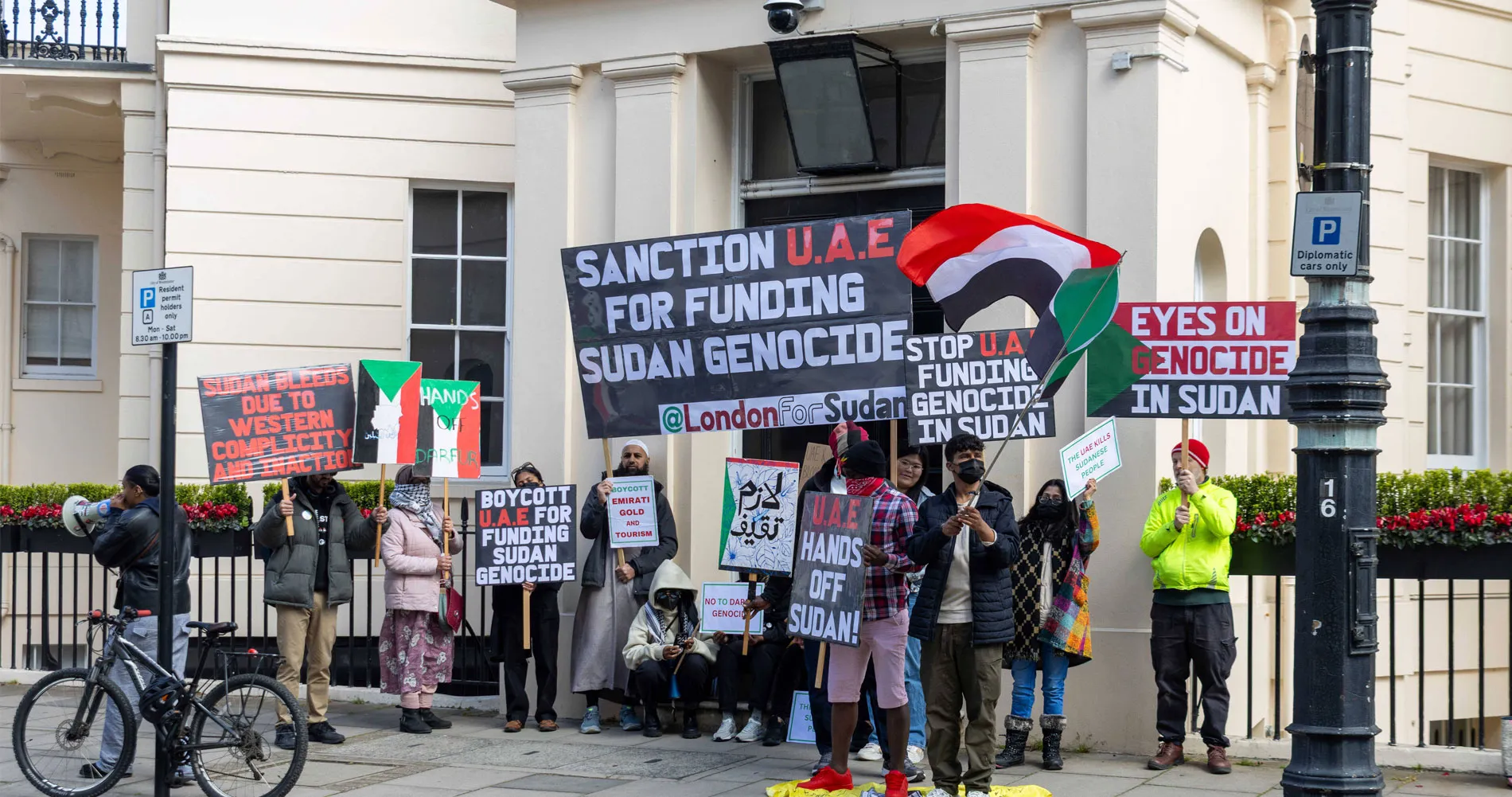
It is easy to narrate Sudan’s tragedy as an internal conflict. Many describe it as a brutal struggle between the Sudanese Armed Forces and the Rapid Support Forces (RSF). That story is only partially true. Sudan’s catastrophe has been prolonged, intensified and strategically shaped by powerful regional backing. Among those external actors, the United Arab Emirates occupies a central place. It is not because the UAE is the only foreign player. It is because mounting documentation links Emirati policy and regional networks to the RSF’s capacity to wage war while the international response has remained noticeably cautious in addressing this. The UAE’s stake in Sudan is neither accidental nor purely ideological. It combines strategic ambition — including longstanding ties to RSF commander Mohamed Hamdan Dagalo, cultivated during Sudan’s transitional period after the fall of Omar al-Bashir — with powerful economic incentives centred on Sudan’s vast gold reserves, which have flowed in increasing volumes through Emirati markets since the war began. Politics and profit are, in this case, difficult to disentangle.
In early 2025 Sudan took the unusual step of filing a case against the UAE at the International Court of Justice. The government in Khartoum accused Abu Dhabi of breaching the Genocide Convention by providing financial, logistical and military support to RSF operations, particularly those affecting the Masalit population in West Darfur. Sudan argued that this support enabled widespread civilian killings, displacement of entire communities, sexual violence and deliberate starvation tactics. The Court declined jurisdiction in May 2025, meaning Sudan suffered a major legal setback.
When the UAE joined the Genocide Convention it carved out the dispute settlement clause of the ICJ – a so-called reservation. This meant that the ICJ did not have jurisdiction over the UAE under this Convention and hence could not order any provisional measures – which are vital in a genocide case. The decision to dismiss the case entirely was supported by 9 judges, with 7 supporting the case to be heard.
Politically the move was still significant. An African state affected by conflict attempted to hold a wealthy and influential Gulf power legally responsible for its alleged role in war crimes, reflecting how seriously Sudan sees foreign involvement in its destruction.
Those allegations did not arise in a vacuum. They are rooted in years of investigative work. United Nations experts, human rights organizations, and major media outlets have documented suspicious cargo flights, intercepted munitions, logistics corridors and financial pipelines linking the RSF to external backers. UN monitoring reports and investigative journalism have described flight patterns from the UAE to Chad and documented weapons found in Darfur that are under scrutiny for potential Emirati links. Crucially, UN panels also emphasise that, while these findings raise serious concerns, the currently available evidence still falls short of conclusively proving a fully established arms-transfer network. That nuance matters, but so does the broader pattern of concern.
Gold is the other decisive pillar of this war. Sudan is one of Africa’s largest gold producers and the RSF has long controlled key mining areas and trading routes. Independent watchdogs and financial analysts have documented rising flows of Sudan-linked gold into the United Arab Emirates since the war began, alongside large volumes routed through neighbouring states before re-entering Emirati markets. This gold translates directly into financial power. It gives the RSF hard currency, access to procurement networks and the ability to pay fighters, secure fuel, acquire drones and maintain logistics. These gold and financing networks help explain how the RSF has been able to sustain prolonged sieges and destructive urban warfare despite international sanctions and condemnation.
Faced with increasing scrutiny, the UAE has shifted its public tone. Senior Emirati officials now acknowledge that their Sudan policy has gone badly wrong, particularly their earlier alignment with Sudan’s 2021 military coup which undermined the country’s fragile civilian transition. After the fall of El Fasher and global outrage at mass atrocities, Abu Dhabi has tried to distance itself from the RSF. It highlights humanitarian flights and diplomatic engagement, and it insists that it does not supply arms. Yet this denial sits beside UN findings, independent investigations and Western intelligence assessments that repeatedly point to concerning external enabling of the RSF’s war capacity.


Here lies the core moral and political contradiction. Western governments have not ignored Sudan. The United States, the United Kingdom and others have sanctioned RSF commanders and affiliated business networks. Some Emirati-linked companies have also faced targeted measures. Yet the state accused of systemic enabling receives a radically different kind of treatment. It remains a valued partner in energy markets, global finance, Red Sea security and broader regional diplomacy. Sudan therefore becomes a humanitarian catastrophe that attracts emotional rhetoric while its most powerful external sponsor avoids direct political consequences.
None of this absolves Sudanese elites. The Sudanese Armed Forces also stand accused of serious abuses and civilians have suffered at their hands as well. Nor is the UAE the only regional power whose actions have shaped the war’s trajectory. But clarity matters. If the RSF’s endurance has depended on external finance, external logistics and external political protection, then serious diplomacy cannot focus only on the generals in Khartoum. It must also confront the governments whose choices have strengthened them.
A credible international response requires three straightforward commitments. The first is to treat Sudan’s conflict gold economy as a security threat rather than a routine commercial issue. Refiners, traders and regulatory bodies need tighter oversight and real penalties for handling conflict-linked gold. The second is to enforce arms embargoes as real obligations. Identified cargo routes and logistics chains should trigger interdiction and accountability rather than carefully worded concern. Intermediaries who conceal state involvement should also face consequences. The third is a principle of political honesty. Strategic partnerships must not function as shields against responsibility. Powerful states should not be able to enable war through proxies while remaining untouchable because they are economically useful or strategically important.
Sudan’s trauma is the result of choices made by men in Khartoum and Darfur and by decisions taken in Gulf capitals and Western policy. Calling this simply a Sudanese conflict is a convenient fiction. It is a regional and international failure as well. The International Court of Justice may have declined to hear Sudan’s case, but the questions raised by that attempt are not going away. Until the world is willing to confront not only the men who pull the triggers but also those who help them acquire the means to do so, peace in Sudan will remain an aspiration rather than a reality.