
Since the war between the US/Isreal and Iran has started in late February, widespread airstrikes have not only hit military and strategic infrastructure but have also caused severe damage to many prominent Iranian UNESCO sites of significant historical value. Is this systematic destruction a coincidence? The US/Israel know exactly where these cultural sights are located. Israel systematically destroyed over 150 cultural and religious sites in Gaza. Mere coincidence or a systematic attempt to erase the Palestinians and now the Iranians from living memory?
Alexandra Dubsky
25 March 2026
Iranian civilization is one of the world’s oldest civilizations with organized urban settlements and archaeological evidence of sedentary life dating back to 8000 years ago (6000 BC). The first, unified, imperial state emerged later with the Medes (625 BC) and Achaemenids (550 BC). Iran’s ancient culture and history is the history and culture of all mankind. Targeting and destroying this common world heritage is a war crime and affects us all.
Among the affected sites are palaces, mosques, and urban complexes that reflect Iran’s long-standing role as a center of civilization. Some of these places have survived invasions, revolutions, and previous wars, only to now face damage in modern aerial bombardments.
According to the Iranian Ministry of Cultural Heritage, Tourism and Handicrafts, at least 56 cultural sites have been damaged over the course of the war. The ministry figures say that the most destruction has been sustained in Tehran, where 19 locations were hit. These include the most famous UNESO site, the Golestan Palace in downtown, the Grand Bazaar and the former Senate building.
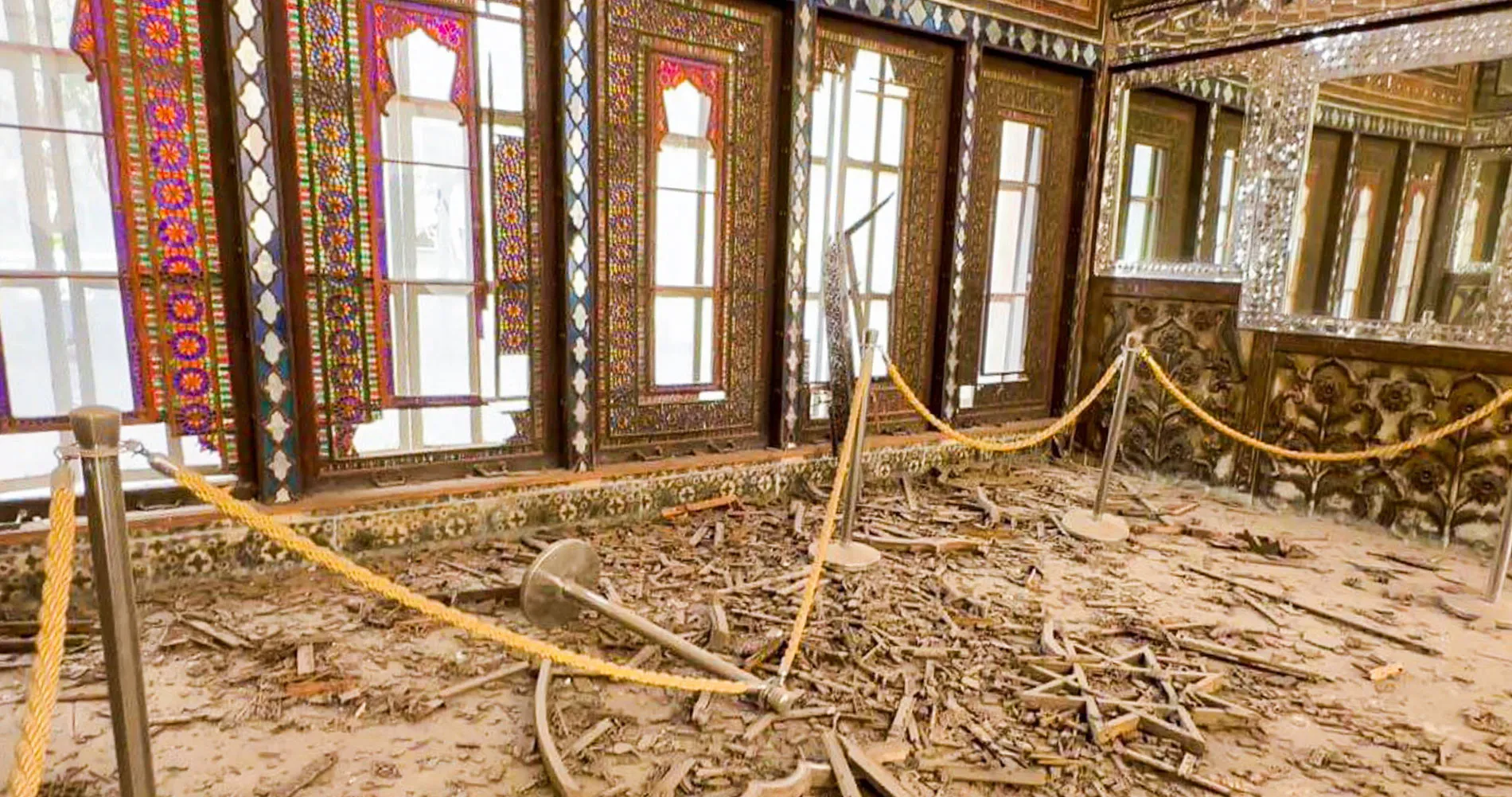
The Golestan palace (see main picture) is the former official royal Qajar complex in Tehran and one of the oldest historic monuments in the capital. It’ s an enclosed complex that blends traditional Persian craftsmanship and architectural design with European artistic influences. Its layout includes landscaped gardens, reflective pools, and elaborate decorative elements. The name “Golestan” translates from Persian as “flower garden.”
“We sometimes even compare it with the Versailles Palace in France,” said the director of UNESCO’s world heritage center, Lazare Eloundou Assomo.
Footage recorded by Associated Press on March 3 revealed extensive damage inside the palace such as fragments of mirrored ceilings scattered across the floors, collapsed archways, shattered windows, and pieces of decorative molding lying beneath its glass-mosaic walls.
In several cases, the damage appears to have resulted not from direct hits but from nearby explosions, shockwaves, or debris. Even so, the consequences have been significant – shattered interiors, structural weakening, and loss of irreplaceable artistic detail.
“In Iran, we as a population have very mixed feelings,” said Rasool Nezrani, a young Iranian man who studies architecture at the TU Vienna, to iGlobenews. “On one hand, we have been waiting so long for anyone helping us to get rid of this horrendous regime that treats their own people so badly. Really, we see the Mullahs just like Nazis, having killed so many of us in previous riots. On the other hand, all these bombings of our civilian infrastructure, that is just not necessary,” he concluded.
With these places being frequently struck, one cannot help but ask the question whether these cultural are sites being deliberately targeted by the US/Israel, or if they are indeed unintended casualties of the broader war on the Ayatollah regime.
UNESCO says it has “communicated to all parties concerned the geographical coordinates of sites on the World Heritage List as well as those of national significance, to avoid any potential damage.” Under international law, all countries must distinguish between military and civilian sites and minimize damage to cultural sites during military conflicts.
“The protection of the cultural heritage of an ancient society such as Iran belongs to all of humanity,” said Sussan Babaie, professor in the arts of Iran and Islam at the Courtauld Institute of Art in London. “This is as crucial to our collective identity as the protection of the Acropolis or the Great Wall of China or the Pyramids in Egypt and Mexico.” She noted 26 UNESCO-designated heritage sites in Iran, which are “testimony to the deep history of civilization on the Iranian plateau.”
Iranian authorities argue that the pattern of destruction suggests more than accidental damage, framing it as an assault on national identity and cultural memory. Some officials have gone further, describing the attacks as an attempt to erase historical continuity.
The Hague Convention (1954), the Geneva Conventions (1949) and Additional Protocols (1977), Article 53 of Additional Protocol I, customary International Humanitarian Law (IHL), Rules 38 and 39 of the ICRC’s Customary Law (International Committee of the Red Cross) and the Rome Statue of the International Criminal Court (ICC) prohibits the targeting of cultural sights, historic monuments, and places of worship during armed conflicts, classifying such actions as war crimes. Such deliberate acts constitute an act of cultural cleansing.
There has been no clear acknowledgment or denial from the United States or Israel that cultural landmarks are intentional targets. Military campaigns in densely populated or historically rich regions often risk collateral damage, particularly when strategic sites are located near heritage zones, according to an official statement of the Israeli military.


Yet if one compares these actions in Iran to Israel’s action during the Gaza Genocide there are undeniable parallels. The Gaza Strip possesses a deep and complex historical legacy, with archaeological evidence reaching back to around 1300 BC. Positioned at a crossroads of civilizations, the area has been shaped over centuries by powers such as the Ancient Egypt, the Ancient Greece, and the Roman Empire. (See also https://www.iglobenews.org/calculated-destruction/).
The region is also home to sites of major religious importance for Judaism, Christianity, and Islam. However, much of this heritage has been devastated in the recent conflict with Israel. According to UNESCO, at least 150 cultural and historical locations have been damaged or destroyed since the war had begun, among them the Anthedon Harbor, Gaza’s oldest known seaport, inhabited between 800 BC and 1100 CE, the Greek Orthodox Saint Porphyrios Church which dates to 425 CE and is often referred to as the third-oldest church in the world, the Qasr al-Basha, a fortress also known as Pasha Palace which was built in the mid-13th century by the Mamluk sultanate and had been turned into an archaeological museum, and a Roman cemetery (Ard-al-Moharbeen), thought to have at least 134 tombs dating back to 200 BC, among others.
Apart from creating an all-inclusive list of the destroyed sites, UNESCO has, however, been relatively quiet in its response to the US/Israeli targeting of cultural sights in Iran, compared with the role the agency has taken in other conflicts. The US returned to UNESCO in 2023 and now covers roughly 22% of the organization’s regular budget, contributing approximately USD 75 million annually.
International law, including conventions supported by UNESCO, obliges warring parties to protect cultural property during armed conflict. Coordinates of major heritage sites are often shared in advance to prevent accidental strikes.
The reported damage has therefore prompted renewed debate over compliance with these norms. Legal experts warn that failure to safeguard cultural landmarks could constitute violations of international law, potentially amounting to war crimes depending on intent and circumstances.
Beyond physical destruction, the loss carries deep symbolic weight. Cultural heritage sites are not only architectural achievements, but they also embody collective memory, identity, and connection. Their destruction can have lasting psychological and societal effects, both within Iran and across the global community.
Bombing Iran’s World Heritage Sights targets the common culture and history of humanity. If Israel’s actions in Gaza serve as a precedent, it is very hard to believe that this destruction is a mere coincidence.