
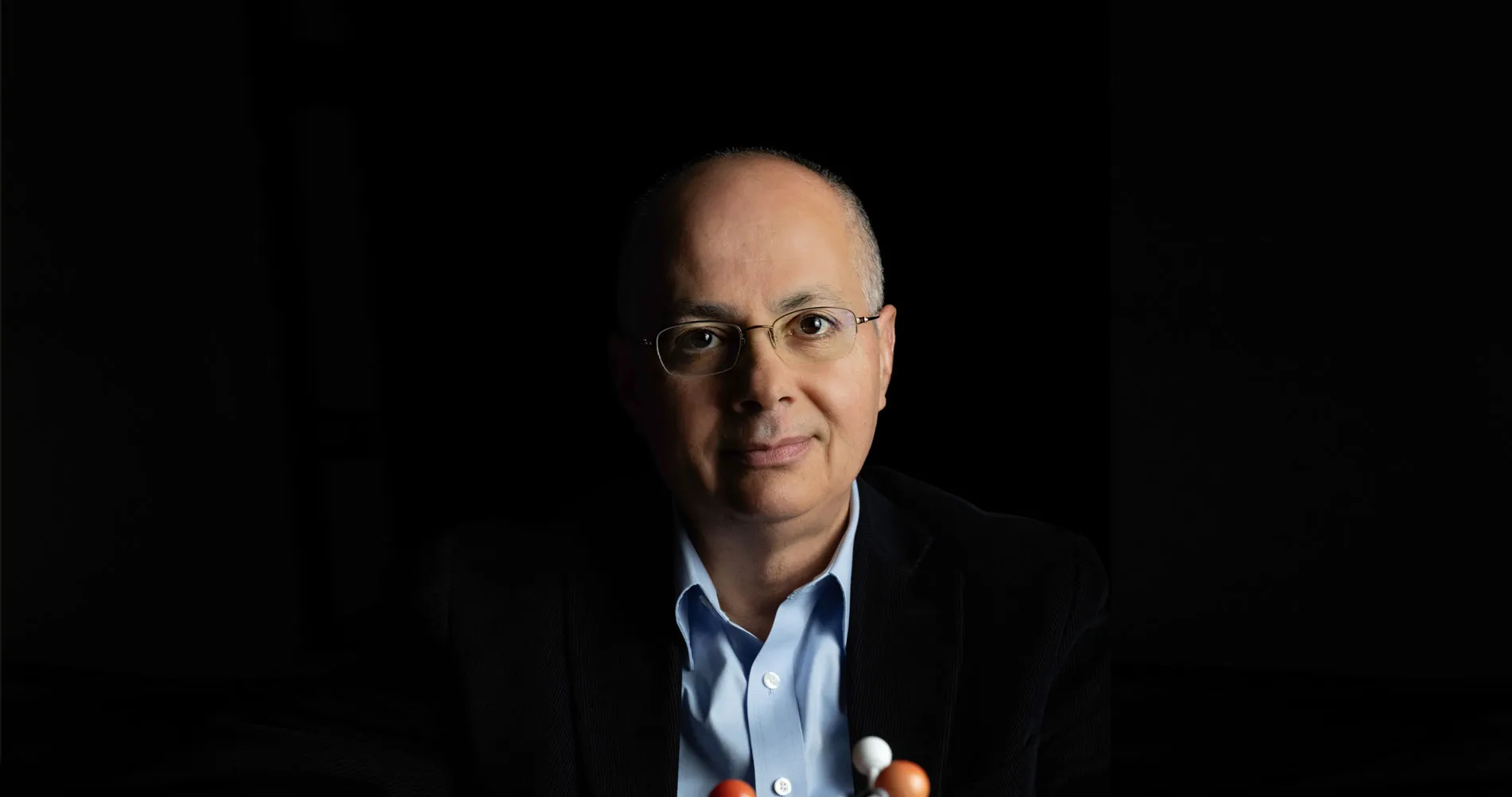
Omar Yaghi, a Palestinian refugee from Gaza, has won the Nobel Prize in Chemistry 2025 together with Susumu Kitagawa and Richard Robson. They developed a new form of molecular architecture in which metal ions function as cornerstones that are linked by long organic (carbon-based) molecules. These metal–organic frameworks (MOF) are building blocks which can be used to drive chemical reactions or conduct electricity. Following the laureates’ groundbreaking discoveries, chemists have built tens of thousands of different MOFs to solve the world’s greatest challenges: separating PFAS from water, breaking down traces of pharmaceuticals in the environment, capturing carbon dioxide or harvesting water from desert air.
Egor Balalykin
29 October 2025
Chinese version | German version | Spanish version
Born in 1965 in Amman, Jordan, to Palestinian refugee parents who hailed from the village of Al-Masmiyya in Gaza, Omar M. Yaghi’s story is extraordinary. Growing up in a crowded one-room home shared with livestock, in a neighborhood where running water appeared for just a couple of hours once in two weeks, he experienced scarcity firsthand. And yet, his background of deprivation and displacement led to one of the world’s most inventive chemists. In 2025 he was awarded the Nobel Prize in Chemistry for his work on metal-organic frameworks (MOFs).
Mr. Yaghi’s grew up in a place with no connection to any laboratory. Both his parents were barely literate. In Jordan, his family lived a simple and poor life. He shared a room with his brothers and livestock, with no electricity and desperate shortage of water. Interestingly, these unfavorable conditions created the interest that would bring him professional success in the future. When he was about ten years old, he visited a library and picked up a book with stick-and-ball pictures of molecules. “I fell in love with them, even before I knew they were molecules”, he told the Nobel Committee.
At 15, on his father’s insistence, he moved to the United States. Despite knowing very little English and a poor background, Yaghi entered Hudson Valley Community College in upstate New York, eventually transferring to the State University of New York at Albany to earn his BSc degree inc. He supported himself financially through bagging groceries and mopping floors. After his undergraduate studies, he went on to pursue a PhD at the University of Illinois at Urbana-Champaign. That t is when he began to ask questions which many chemists considered unthinkable. In his words: “I set out to build beautiful things and solve intellectual problems”.
The result was the birth of the field of reticular chemistry. This refers to the deliberate construction of extended crystalline structures using strong bonds between molecular building blocks. MOFs became his signature achievement: ultralight, highly porous frameworks where the pores can be tailored to trap gases, harvest water, catalyze reactions or store energy. More than 100 000 distinct MOF structures have been synthesized, each customizable for different functions, which was a spectacular leap from the earlier fragile coordination polymers that plagued many experiments. For example, Mr. Yaghi’s group developed MOFs that extract water vapor directly from desert air, and this idea seems to be rooted in his own childhood experience of water scarcity.
On 8 October 2025, Yaghi was awarded the Nobel Prize in Chemistry, together with Susumu Kitagawa from Japan and Richard Robson from Australia for their development of “molecular constructions with large spaces through which gases and other chemicals can flow.” The Noble Committee described their work as “previously unforeseen opportunities” to combat global challenges such as water stress and carbon emissions.
Yaghi received the call on his way from the US to Frankfurt on a transfer during a flight. Someone may see this as an interesting gesture of fate, when a person whose family experienced displacement receives such a prestigious award while on a long trip. In accepting the Nobel Prize he emphasized that “science is the great equalizing force in the world” and that talented people exist everywhere, given opportunity.

Susumu Kitagawa, Richard Robson and Omar Yaghi © Niklas Elmehed for Nobel Prize Outreach
Despite his laureate status, Mr. Yaghi remains grounded in his childhood experience. He recalls water delivery every two weeks, rising at dawn to open the taps for family and cows alike. He still stresses that he did not set out to solve the world’s water problem, but rather he started by “building beautiful things and solving intellectual problems.” He has established research institutes such as the Berkeley Global Science Institute which aim to provide opportunities globally, so that talent “wherever it is can thrive”.
His story stands in contrast to the statements that one can hear from the Israeli far-right. On 9 October 2023, when Israel declared war on Hamas and tightened its blockade of the Gaza Strip. Israeli Defense Minister Yoav Gallant declared “… We are fighting human animals and we are acting accordingly. ”
Contemporary discourse in that camp frames Palestinians not merely as adversaries, but as entities that are sub-humans which do not and should not have the same rights. Such rhetoric does more than offend, and may lead to disturbing consequences. By categorizing a whole people as sub-human or disposable, it opens the door for policies of extreme violence, collective punishment, and structural exclusion.


Rejecting this narrative is essential. To treat someone as less than human because of their background erodes the very foundation of universal human rights. Opposing Israeli far-right rhetoric and policies and defending Palestinian rights and dignity are, therefore, not a secondary concern but rather a test of whether we live in a world where every human being is respected, and provided with opportunities for fulfilling their potential.
As Omar Yaghi’s story proves, Palestinians are capable of enormous professional successe. His achievements demonstrate that origin or ethnicity cannot, and should not, define one’s potential. Moreover, judging or discriminating against someone based solely on their origin is not only unjust and unethical, but also ultimately anti-humanist and delusional.
Omar Yaghi’s path from the child of Palestinian refugees to Nobel Laureate also captures something profound about science’s potential and unique importance.