
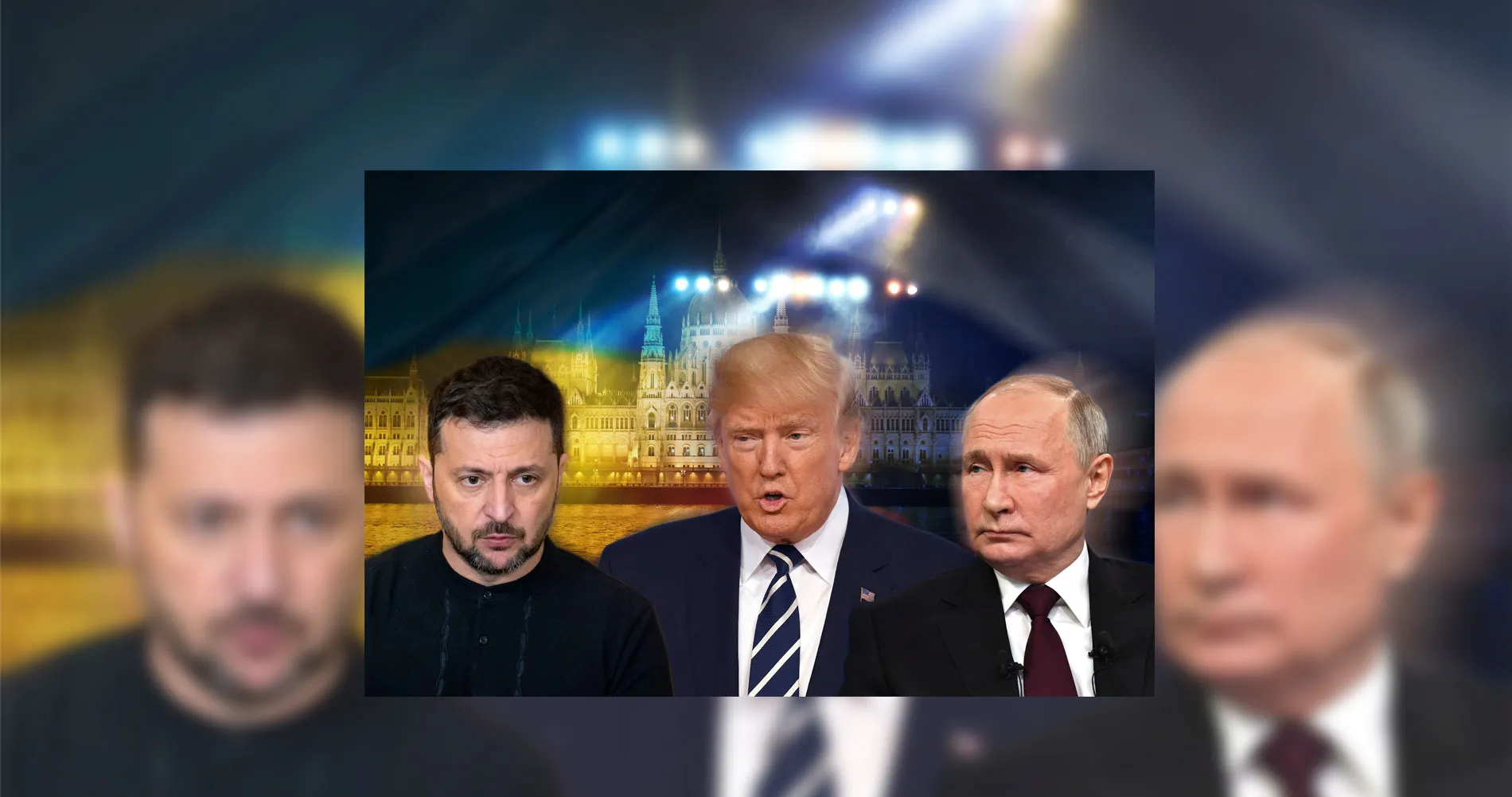
The peace talks between Ukraine the US and Russia are at an impass. The ever-growing corruption scandal surrounding the entire government of President Zelensky has come at the worst possible time for Ukraine. President Trump has already stated unequivocally that Ukraine will not join NATO and has pushed any possible US security guarantees into the future. Without US support, Ukraine is doomed. Could a neutral Ukraine, modelled after the Austrian model of neutrality, move the peace process forward?
Heinz Gärtner
4 December 2025
German version
Neutrality was a concept that made it possible to keep the Cold War blocs at bay. To a certain extent, it guaranteed the political independence of neutral states. These states did not join any military alliances, but their values and economic systems were oriented toward the West. In Central Europe, only Austria retained a neutral status after 1955. Nevertheless, ideas were developed as to how the Austrian model of neutrality could serve as a solution to other unresolved problems.
In 1954 and 1955, the USA had already developed a positive view of neutrality. Its international significance was not rejected, but examined in terms of practicability, suitability, durability, and solidarity. Neutral states were not regarded as subjects of a third power that would fall under Communist-Soviet dependence. Nevertheless, Washington was well aware that neutrality would accommodate Soviet security needs.
US President Dwight Eisenhower remarked in 1956: “Today, there are some states that describe themselves as neutral. This does not necessarily mean, as is so often said, that they are neutral between right and wrong or decent and indecent. These states apply the term ‘neutral’ to their relationship with military alliances. And I would like to emphasize that I see no reason why this should always be to our disadvantage.”
Eisenhower’s view should be seen in the context of his attempt during the 1950s to withdraw more American troops from Europe and encourage Europeans to contribute more to their own defense. For this reason, the US government repeatedly emphasized that neutral states must be armed. It was also important to President Eisenhower that Austria’s neutrality be “armed” so that it would not create a military vacuum.
In May 1955, Eisenhower commented on the question of Austria’s neutralization as follows:
“And I would like to say the following: There seems to be a growing idea that a series of neutralized states could be established across Europe from north to south. Well, remember: The treaty on the neutralization of Austria does not say that Austria will be disarmed. It is not a vacuum, not a military vacuum; it is modeled on Switzerland. Switzerland is obliged to maintain its own neutrality, and I believe it would fight to the death for it. This kind of neutrality is quite different from a mere military vacuum.”
Eisenhower agreed to Austrian neutrality only on condition that Austria be able to defend its neutrality. Between 1955 and 1959, the US therefore supported the establishment of the Austrian armed forces with $80 million and subsequently with various training programs. (National Security Council, 1960) The Soviet Union apparently had no problem with Austria’s neutrality being guaranteed by a strong army.
This was a clear commitment that was reinforced four years later. A 1960 National Security Council document, approved by President Eisenhower on January 18, 1961 (two days before John F. Kennedy’s inauguration), formulated the goal “to maintain Austria’s independence and stability and encourage it to continue its pro-Western course, as well as to resist pressure and blackmail from communism.” One of the main political objectives was to treat any violation of the integrity of Austria’s territory or its neutrality as a serious threat to peace.
There have been a number of proposals regarding neutrality in Central Europe. George F. Kennan, who developed the concept of containment policy as US ambassador to Moscow after 1947, proposed neutrality for Central Europe and a united Germany in 1956 and 1957 because he did not believe in the sustainability of the division of Europe and Berlin. He made the following remarks in 1967:
“It has always been my view that the release of Eastern Europe from the unnatural bondage in which it has been held in recent years would be facilitated if the line separating the American and Russian military blocs were not too strongly emphasized and if the neutral zone between them could be expanded rather than reduced.”
Kennan welcomed the fact that Sweden had not joined the Atlantic Pact NATO, that Switzerland had maintained its traditional neutrality, that Austria had become neutral, and that Yugoslavia had not aligned itself with either the West or the East. Neutral states should not be expected “to promise to defend us in the event of war, but rather to maintain a clear view of their own interests and to resist vigorously any undue pressure, from whatever quarter it may come, in war or in peace.”


In the second half of the 1950s, alongside the debate on neutrality, a debate on “disengagement” had begun in the context of several proposals on collective security. The idea was to create a region of common security and reduce bloc confrontation. These ideas of collective security were supplemented by the proposal for a “nuclear-weapon-free zone.” Austria, as a non-nuclear neutral state, thus also became a model for the Rapacki Plan.
Against this backdrop, in 1957 and 1958, Polish Foreign Minister Adam Rapacki made proposals for nuclear-weapon-free zones covering Poland, Czechoslovakia, the German Democratic Republic, and the Federal Republic of Germany (Austria was already nuclear-weapon-free). Nuclear weapons were not to be produced or stored in this territory. At the same time, the stationing of facilities intended for their operation and the actual use of nuclear weapons in this zone would also have been prohibited.
The Rapacki Plan, in turn, served as a model for various proposals for nuclear-free zones in Europe. For example, in 1982, the Palme Commission proposed a nuclear-weapon-free zone on the “battlefield” of Central Europe, which could be extended from the Baltic States to the Balkans.
Austria’s nuclear-weapon-free status is enshrined in the State Treaty of 1955 which stated that:
“Austria shall not possess, manufacture, or attempt to use: a) any nuclear weapon, b) any other weapon of mass destruction that can be used now or in the future as a means of mass destruction and has been designated as such by the competent organ of the United Nations …”
Regarding Austria, and possible solutions to the Russia-Ukraine conflict, the key question is whether neutrality is compatible with a future security-related arrangement for Ukraine. After the war in Ukraine, political borders will likely be determined by where armies stand, as in Germany and Korea after World War II. In any future peace agreement, President Putin cannot expect both to keep all Russian-controlled territories and to have Ukraine renounce NATO membership, while President Zelensky is unlikely to achieve full Russian withdrawal and NATO accession. NATO members, meanwhile, must recognize that military alliances alone cannot ensure Ukraine’s absolute security.
A model resembling Austria’s neutrality could provide a compromise, involving Russia’s gradual withdrawal from occupied territories in exchange for Ukraine’s pledge to forgo NATO membership and foreign troop deployments, while maintaining the prospect of EU membership.