
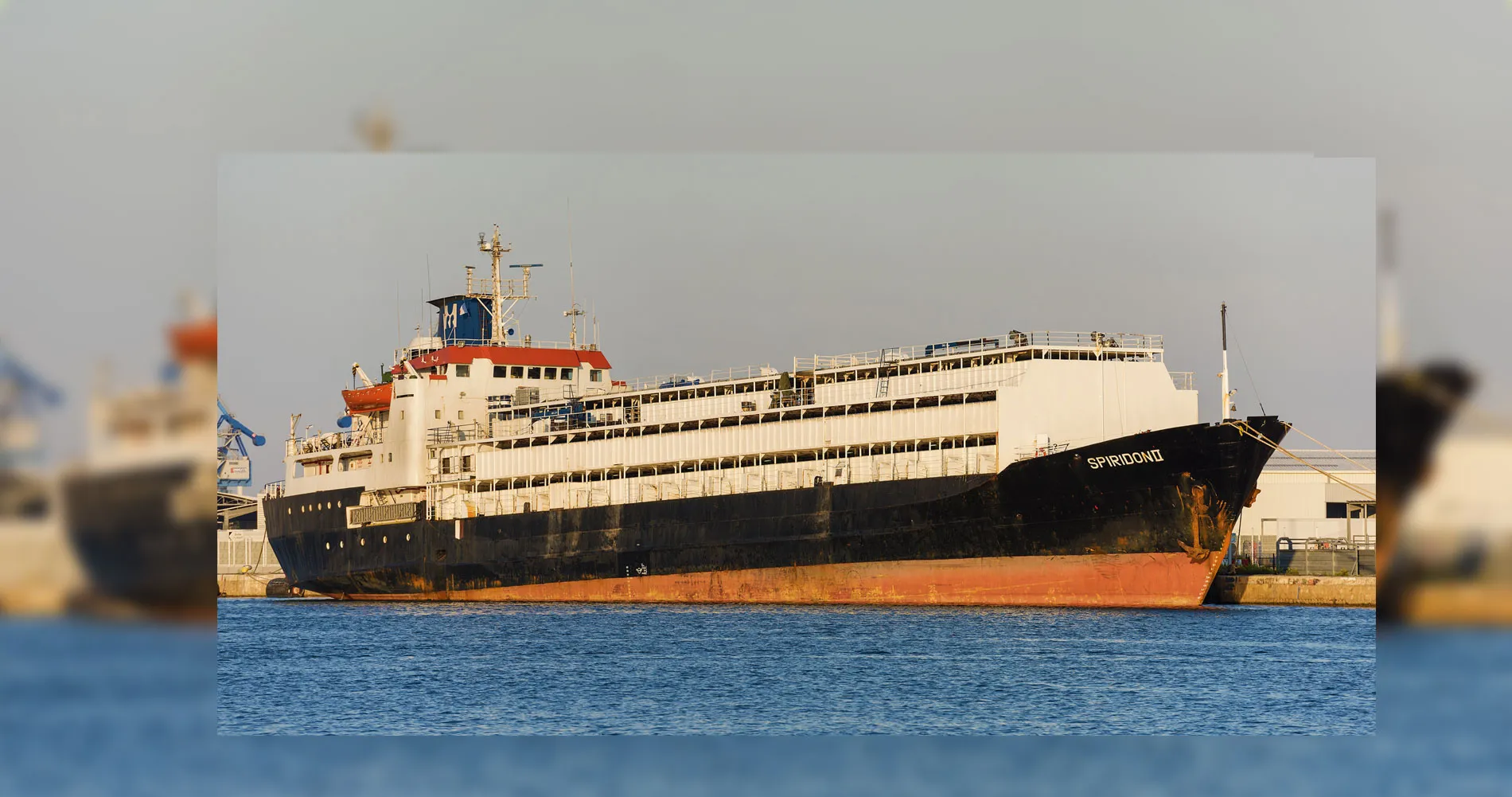
Nearly 3000 cattle were stranded aboard the livestock carrier Spiridon II for weeks after Turkey refused port entry, exposing severe animal suffering and regulatory failure. The case reveals how fragmented international laws, weak enforcement, and the live-export trade leave animals trapped when bureaucratic systems collapse.
Daniella Vanova
4 March 2026
In the autumn of 2025, for weeks, the livestock carrier Spiridon II drifted in and out of public view off the coast of Turkey. A floating symbol of regulatory failure and animal suffering. On board were nearly 3000 cattle, many of them pregnant, confined in overcrowded pens, standing knee-deep in their own faeces as food supplies dwindled and deaths mounted. What began as a routine live-export voyage from Uruguay to Turkey slowly transformed into an international scandal, marked by port refusals, legal deadlock, and disturbing allegations that dead animals were thrown overboard.
As the ship lingered offshore at times disappearing from tracking systems animal welfare groups, maritime experts, and journalists began asking questions. Why were the animals not allowed to disembark? Who had the legal authority to intervene? And how could such extreme suffering occur under international laws supposedly designed to protect both animals and the marine environment?
The story of the Spiridon II reveals how fragmented responsibility, weak enforcement and rigid bureaucracy can leave thousands of animals trapped in a legal and physical limbo.
The Spiridon II, a 52-year-old livestock carrier flying the flag of Togo, departed Montevideo, Uruguay in late September 2025 with approximately 2900 cattle on board. The animals were destined for Turkey as part of the global live-export trade, a controversial industry that transports millions of animals by sea each year.
When the ship arrived off the Turkish port of Bandırma in late October 2025, it should have marked the end of a long journey. Instead, Turkish veterinary authorities refused to allow the cattle to be unloaded. Officials cited irregularities in documentation and ear-tag identification, stating that some animals could not be reliably traced or did not match import records.
Under Turkish law, such discrepancies are grounds for refusal. Traceability is considered essential for disease prevention and food safety, and authorities insisted they could not make exceptions. While the ship was briefly permitted to dock to replenish feed and water, the animals themselves were ordered to remain onboard. Days turned into weeks.
As the stalemate dragged on, conditions for the cattle reportedly became dire. Livestock vessels are designed for movement, not indefinite confinement. Animals were forced to stand continuously in cramped pens, surrounded by accumulated waste. Ventilation was limited, ammonia levels increased, and the risk of respiratory illness and infection grew.
Animal welfare organizations reported that dozens of cattle died during the voyage, with some estimates suggesting a far higher number of deaths. Pregnant cows reportedly gave birth onboard, yet many calves did not survive the filth and lack of care. Observers also raised alarms about unexplained gaps in animal counts and alleged sightings of carcasses being handled in ways that suggested disposal at sea.
If true, such actions would violate the MARPOL Convention, which strictly prohibits the dumping of animal remains and waste in sensitive marine areas such as the Mediterranean. However, proving such violations at sea is notoriously difficult, particularly when ships change course, switch off tracking systems, or operate under flags with weak oversight.
Turkey’s refusal to allow disembarkation lies at the heart of the crisis. Legally, the country was within its rights to enforce import regulations. Port State Control allows nations to deny entry to vessels or cargo that do not meet health and documentation requirements.
Yet critics argue that the response exposed a lack of humanitarian contingency planning. There is no clear international obligation requiring a state to allow animals ashore when welfare conditions deteriorate, even if refusing entry results in prolonged suffering. Once Turkey denied unloading, responsibility effectively bounced back and forth between the exporter, the ship operator, and the flag state while the animals remained trapped.
The Spiridon II was registered in Togo, a flag of convenience with a poor safety record. Under international maritime law, the flag state is responsible for ensuring that vessels comply with safety, environmental, and welfare standards.
In practice, enforcement by some flag states is minimal. The Spiridon II had a history of deficiencies and detentions, raising questions about how it was allowed to transport thousands of live animals at all. The ship’s age, condition, and compliance record have all been cited as warning signs that were ignored long before the crisis unfolded.
International animal welfare standards, such as those set by the World Organisation for Animal Health (WOAH), outline principles for humane transport. These include fitness for travel, adequate space, veterinary supervision, and emergency planning. However, these standards are not binding in the way maritime safety conventions are, and enforcement depends largely on national authorities.


Once the voyage went off script, there was no effective mechanism to force cooperation between exporting and importing states, no emergency protocol to prioritize animal welfare, and no international authority empowered to intervene decisively. The cattle became, in effect, legally stranded — unable to move forward or backward without violating someone’s regulations.
Who will be take responsibility for the Spiridon II disaster?
The exporters and ship operators failed to ensure flawless documentation and chose a vessel with a questionable history. The flag state failed to enforce meaningful standards or oversight. Turkey, while acting within its legal framework, declined to create a humanitarian exception that could have prevented prolonged suffering. And the international system itself failed to provide a safety net when the rules collided.
This diffusion of responsibility is not accidental it is built into the live-export system.
Eventually, the Spiridon II was ordered to leave Turkish waters and began a long return journey. Finally, after a 66-day martyrdom, the cattle were unloaded in the Libyan city of Benghazi on or around 22-25 November 2025.
When the ship docked in Beirut on 27 November 2025 it was empty.
What is clear is that this was not an isolated incident. Similar cases have occurred repeatedly over the past decade, each revealing the same structural flaws: aging vessels, weak oversight, fragmented legal authority, and animals paying the price when trade goes wrong.
The ordeal of the Spiridon II was not caused by a lack of laws, but by the gaps between them. It was a legal stalemate enabled by a system that treats animals as cargo first and sentient beings second.
Unless governments close those gaps and create enforceable, welfare-centered rules for live exports, the question is not whether another ship like the Spiridon II will drift helplessly at sea – but when.