
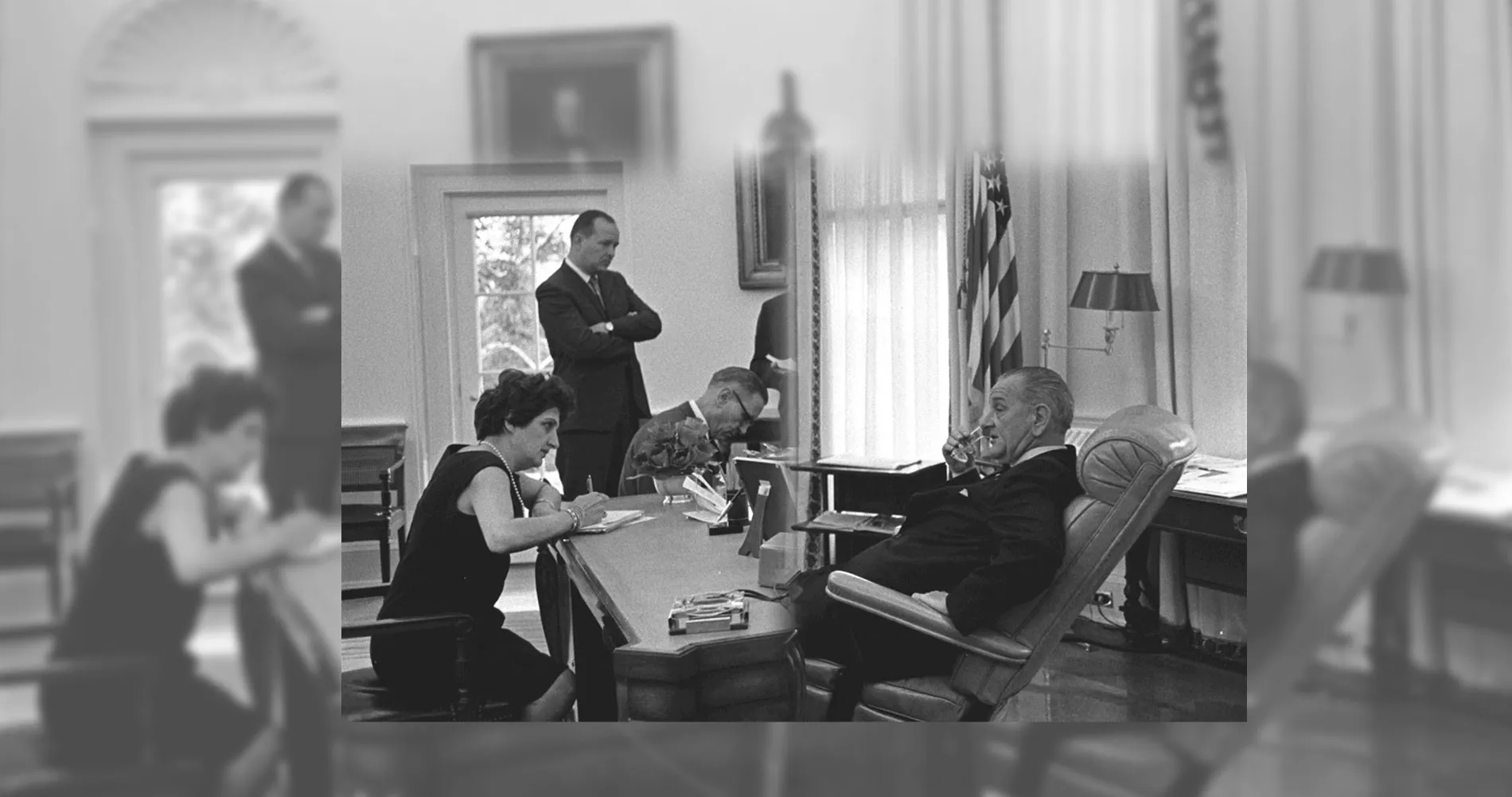
Helen Thomas (1920-2013) spent decades at the centre of American power, questioning presidents and shaping political journalism from the White House briefing room. A pioneer for women and Christian Arab Americans, her career combined historic firsts with a relentless commitment to accountability – until one comment standing up for Palestinian rights forced a sudden and debated exit.
Silvia Caschera
4 May 2026
Russian version
Helen Thomas’ life can be read as a history of American power viewed from the front row, told by a journalist who refused to soften her questions. A pioneer for women and Arab Americans, she was also among the earliest voices in Washington to insist that Palestinians were an occupied people whose rights could not be indefinitely ignored.
Born in 1920 in Kentucky to Christian Lebanese immigrant parents and raised in Detroit, Thomas decided early to become a journalist, drawn by curiosity and a desire to ask meaningful questions. After graduating from Wayne State University in 1942, she moved to Washington, DC, in 1943 to join United Press (later UPI). Entering the press corps as an Arab American woman in the 1940s meant navigating a profession dominated by men, yet she soon proved she was just as capable as her male counterparts when covering major national stories.
Her career gained momentum in the mid-1950s with assignments at the Department of Justice, Capitol Hill, the FBI and other federal institutions. These roles sharpened her tenacity and embedded her in Washington’s political machinery. Her first presidential assignment – covering John F. Kennedy’s family vacation – made clear that the White House was where she belonged. From then on, she became a constant presence at press conferences, developing the direct and sometimes irreverent questioning style that would define her career and earn her the unofficial title of “Dean of the White House Press Corps.”
Across ten presidencies, from Kennedy to Barack Obama, Thomas became a regular in the briefing room. For nearly thirty years, her formal “Thank you, Mr. President” signalled the end of press conferences. Promoted to White House correspondent for the UPI in 1970, she reached a symbolic milestone in 1972 as the only print reporter to accompany Richard Nixon on his trip to China. At the same time, she helped dismantle gender barriers in journalism, pushing institutions like the National Press Club to admit women and later becoming the first female officer or president of several elite journalistic bodies.
Her influence was based not only on these “firsts” but on her questioning. As UPI’s White House bureau chief from 1974 to 2000 – the first woman to hold such a role at a major wire service – she shaped coverage of the presidency. Her questions on Vietnam, civil rights, the Iran-Contra affair, the Gulf War and the Iraq War were concise, direct and often framed from the perspective of ordinary citizens. Her Lebanese background made Middle East policy personal as well as political. In a 2006 exchange with George W. Bush, she pressed him on the true motives behind the Iraq War, refusing to accept rehearsed answers and focusing on civilian consequences.
In 2000, Thomas resigned from UPI after its acquisition by a company linked to Rev. Sun Myung Moon, underscoring her commitment to editorial independence. She joined Hearst as a syndicated columnist, gaining greater freedom to express views she had previously implied, while continuing to question Presidents from the front row until 2010.
Her White House career ended abruptly following remarks made during a short interview by what was later revealed to be an ADL operative at a Jewish Heritage Month event in May 2010. When asked about Israel, she said, “Tell them to get the hell out of Palestine,” adding that Palestinians were occupied and that Israelis should “go home” to countries such as Poland, Germany or the United States.
The questions of the ADL operative were leading and designed to entrap Thomas. Filmed and widely circulated, the comments were interpreted as a call for Jews to return to countries, some associated with the Holocaust, triggering immediate backlash. This was not Thomas’ intention. Although she issued an apology emphasizing her belief in mutual respect and peace, she maintained that her core point concerned occupation and dispossession rather than Jewish existence.
The ADL (Anti-Defamation League) and other Zionist organization/strategists had long sought her removal from her influential position as White House correspondent and used these comments to ruin her career and reputation. The ADL is a pro-Israel Zionist New York-based international advocacy organization and now has close links to the Israel Lobby.
Although many came to Thomas’ defense, including Ralph Nader, Fox News contributor Ellen Ratner, UPI managing editor Michael Freedmans and The Nation editor and publisher Katrina van Heuvel, nothing could save her from the crushing reaction of what one now calls the Israel Lobby and its operatives. She was called an antisemite although Thomas herself was a Semite. Former colleagues distanced themselves, honors were withdrawn, and even an award bearing her name was retired.


The White House Correspondents’ Association condemned her remarks, the White House called them offensive, and commentators across the political spectrum demanded consequences. Hearst announced her retirement almost immediately, ending her role just short of her 90th birthday.
The episode exposed deeper tensions of the marginalization of Arab and Palestinian perspectives in US discourse and the limits of acceptable criticism of Israel in American discourse. It blatantly showed the limits of free speech when it came to Israel. As an Arab American woman who had already broken gender barriers, Thomas was articulating a perspective widely discussed internationally but often treated as unacceptable in the Washington of her day.
Thomas was not only the first female White House correspondent, but one of the first advocates for Palestinian rights. Just as she had challenged presidents on Vietnam and Iraq, she now pressed for recognition of occupation and illegal settlement in Palestinian territories. Arab American and Palestinian groups later praised her as a defender of justice, while her story became a cautionary example of the limits of journalistic speech when it comes to criticizing Israel.
Viewed from the 2020s, amid renewed scrutiny of the Gaza genocide and Israel’s expansion into the West Bank, her assertion that Palestinians are an occupied people is no longer contentious or offensive, but widely accepted.
In 2010, in a radio interview, Thomas said that “you cannot criticize Israel in this country and survive.” Little changed until the US-Israel war against Iran in 2026, which the majority in the US and most of Europe and the world do not support. This has led to increased awareness of the injustice to Palestine and to political and popular support for a Palestinian state.