
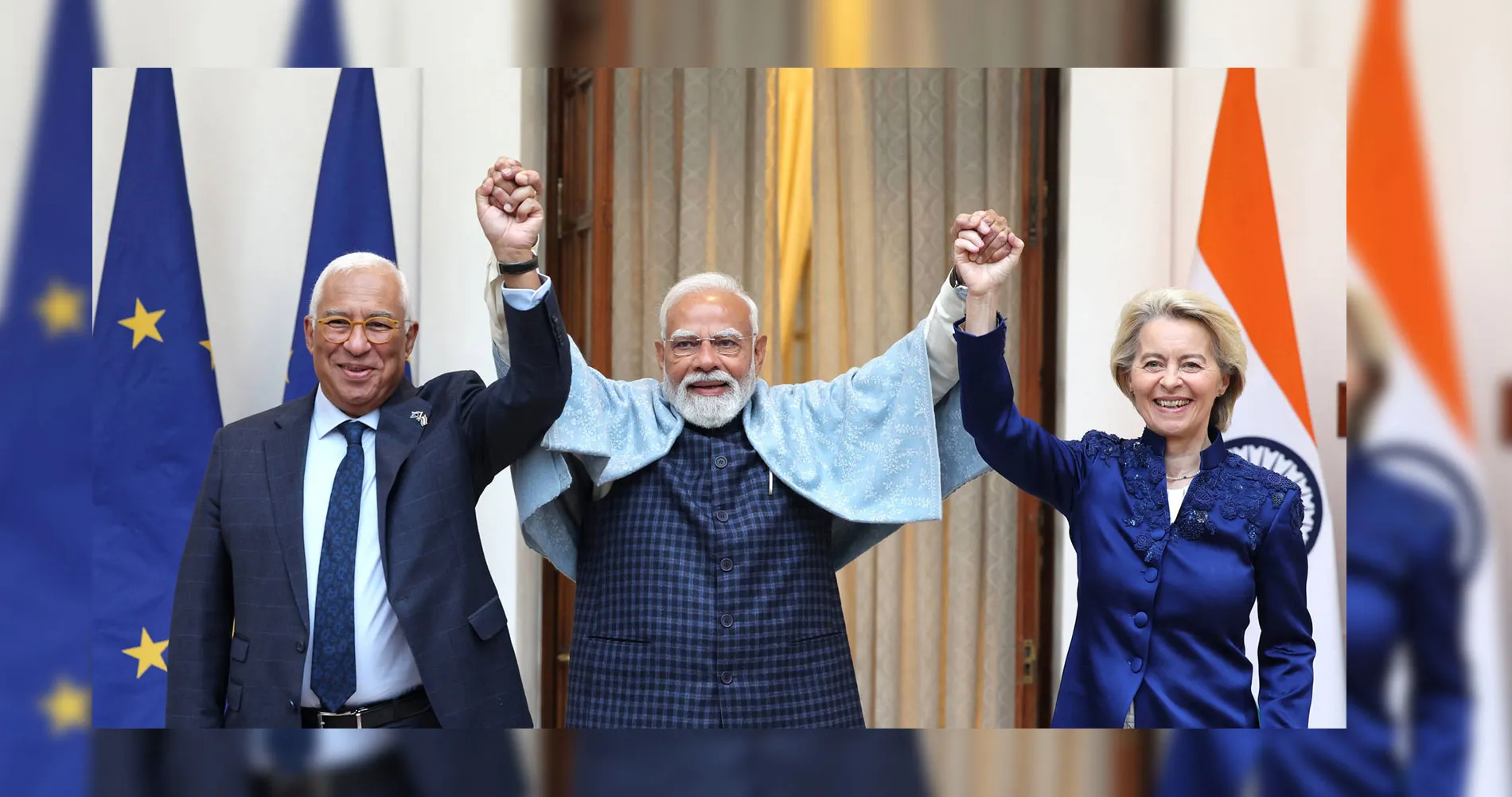
As Washington retreats behind a wall of tariffs and restrictive visas, Brussels and New Delhi have signed the “mother of all deals”. Given that the two sides together represent nearly 2 billion people and around a quarter of global GDP, the label is not entirely misplaced.
Meric Sentuna Kalaycioglu
30 March 2026
On 27 January 2026, the European Union (EU) and India finally did what many thought impossible: they signed a comprehensive Free Trade Agreement (FTA) after nearly two decades of stalled talks. Still, this is not just a trade story. The agreement comes at a moment when the global economic order is under strain. US President Donald Trump’s renewed and often unpredictable use of tariffs as a foreign policy tool has created pressure on major economies to secure alternative partnerships. Both Brussels and New Delhi have felt the impact of Washington’s “America First” approach. Concluding the FTA now adds a layer of urgency that was missing in previous rounds of talks twenty years ago.
However, beneath these handshakes and the promise of doubling EU exports to India by 2032, a more complex reality is emerging. For the EU, this agreement offers both significant benefits and serious risks. While it gives European businesses a strong position in the world’s fastest-growing large economy, it also creates organizational difficulties that could fundamentally change the European labor market and its most successful industries.
The high-tech industry will feel the effects first. As the United States (US) continues to tighten its borders under a restrictive “America First” agenda—marked by delays in the H-1B visa (a program that allows US companies to temporarily employ foreign workers in highly specialized fields like IT, engineering and medicine) and increased scrutiny of Indian tech talent—the EU has moved in the opposite direction. A new mobility framework, agreed alongside the FTA, aims to facilitate the entry of skilled Indian professionals, researchers and students. The creation of a European Legal Gateway Office in India and a high-level EU–India Education and Skills Dialogue are meant to smooth recognition of qualifications and match skills with shortages, starting with the ICT (information, communications and technology) sector. By easing the movement of natural persons, the EU is effectively positioning itself as the primary destination for the Indian talent that Washington is currently turning away.
From a European perspective, this is a necessity driven by demographics. With a shrinking workforce and a persistent shortage of software engineers and data scientists, the EU needs Indian talent to fuel its Digital Decade Policy Programme 2030, known as “Digital Decade” goals. However, the move does not come without its serious downsides such as potential wage suppression and more competition for entry-level European workers. The danger is that while increasing the number of work visas solves the problem of the immediate lack of skilled staff, it might also reduce the pressure to develop the local workforce if European companies choose to hire already-trained international professionals instead of investing in internal training programs.
The real challenge, however, involves pharmaceuticals. India, often described as the “pharmacy of the world,” already supplies a large share of the medicines and active pharmaceutical ingredients (APIs) used in Europe. A trade deal would likely deepen that role by reducing or eliminating tariffs on a broad range of pharmaceutical and chemical products, giving Indian manufacturers easier access to the EU’s EUR 390 billion pharmaceuticals market. In return, India would cut duties of around 10–11 percent on European medicines, improving market access for EU drugmakers.
At the same time, Brussels is pursuing a different and competing objective: reducing external dependencies on critical pharmaceutical products. For years, the EU has relied on China for many of its pharmaceutical ingredients. Following supply shortages during the COVID-19 pandemic, the European Commission proposed the Critical Medicines Act, which is currently being negotiated with the Council of the EU. The legislation aims to secure supply chains and encourage more production of essential medicines within Europe. Closer trade ties with India could help diversify suppliers, but they will likely also increase reliance on imported inputs rather than support domestic manufacturing.
While this is a win for EU healthcare systems looking to cut costs, this outsourcing of critical medicines complicates the EU’s strategic autonomy goals. So, the question remains: is the EU trading its reliance on one country for another?
In Brussels, some assume this deal was signed primarily to send a message to the White House. The timing is hard to ignore. As the US effective tariff rate surged in 2025 to levels not seen in a century, the EU-India FTA serves as a loud declaration of European attempts at strategic autonomy.


At the same time, the deal cannot be seen as a simple reaction to the US. EU-India negotiations date back nearly two decades and cooperation has deepened in recent years, including the launch of the EU–India Trade and Technology Council in 2023. The EU is already India’s largest trading partner and its second-largest export market. India, for its part, has concluded trade arrangements with the UK and EFTA countries, underlining that the broadening of its economic alliances. In that sense, the EU-India agreement reflects a larger s shift towards diversified partnerships in a more fragmented global economy.
Who really gains? At first glance, both sides seem to walk away satisfied. The EU expects to save approximately EUR 4 billion per year in duties. European farmers, long barred from the Indian market by prohibitive duties, will see tariffs on wine and olive oil slashed from 150 percent and 45 percent respectively to much lower levels over the coming decade.
Moreover, the EU-India FTA also fits into EU’s de-risking strategy: reducing overdependence on China while keeping markets open with access to 1.45 billion Indian consumers and a vital pipeline of talent.
Yet, for India, the prize is the vote of confidence: by aligning its production with EU regulatory standards, India will be integrated into European value chains, reducing its reliance on China and avoiding Trump’s impulsive tariff policies.
The agreement is, therefore, not just a pragmatic adjustment to a more uncertain environment but a reflection of long-standing negotiations brought to a close at a moment of geopolitical pressure. Whether it delivers balanced gains will depend not only on tariff cuts, but also on how both sides manage labor mobility, sectoral policy and regulatory alignment in the years ahead.