
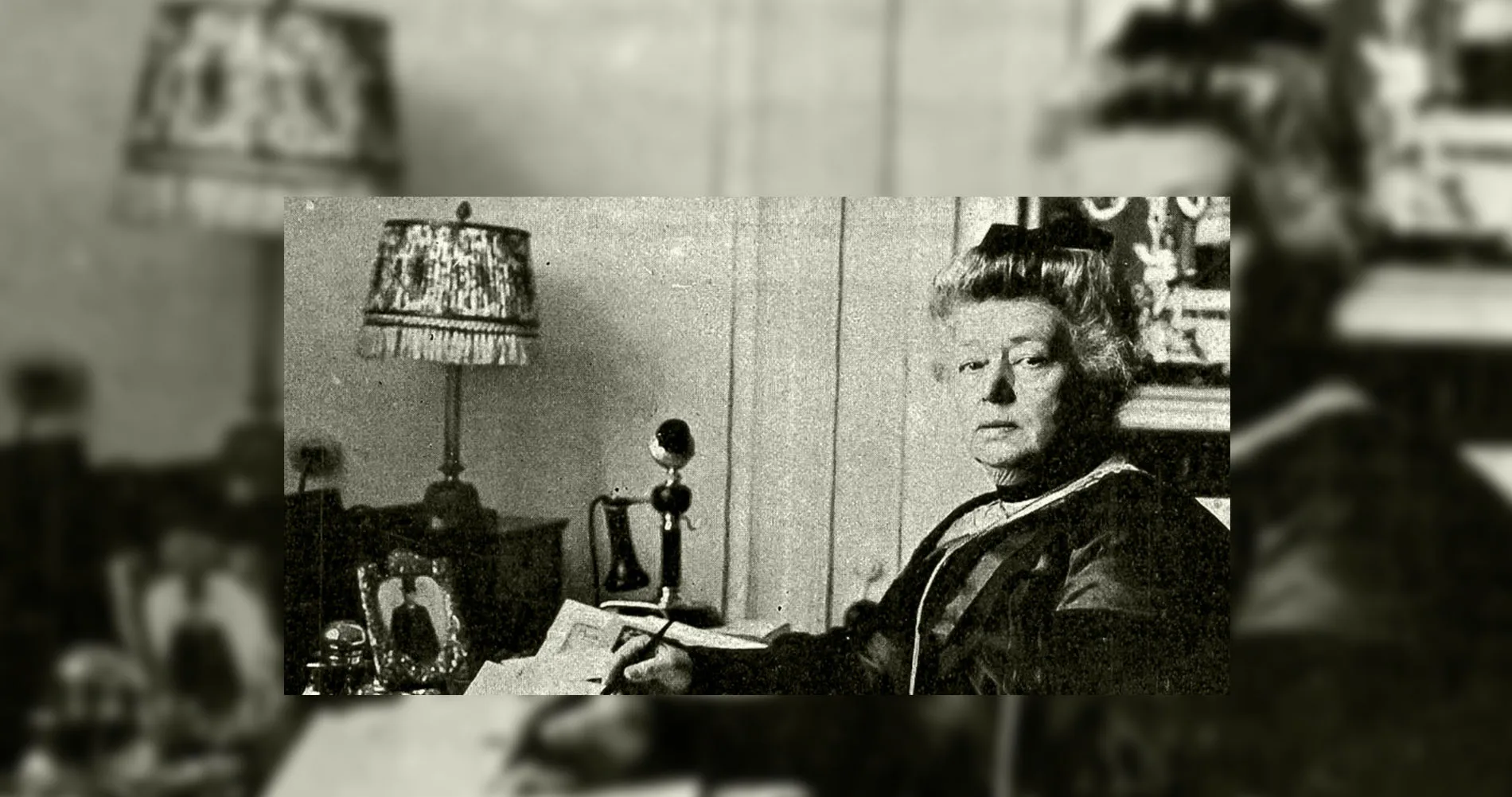
The life and work of the Austrian Bertha von Suttner, a pioneer pacifist and first women to receive the Nobel Peace Prize in 1905, remains visionary and relevant. After 120 years her achievements for women’s rights and her peace activism are unrivaled. Often mocked during her time for leading an unconventional life and called “Peace Bertha”, she is considered today to be one of the driving forces behind Alfred Nobel’s Peace Prize.
Alexandra Dubsky
23 March 2026
German version
When Bertha von Suttner was born on 9 June 1843 in Prague as Bertha Sophia Felicita Countess of Kinsky von Wchinitz und Tettau, her fate, like that of most daughters in high society, was predetermined by her social status. She was expected to marry according to her class, have children, raise them as good Catholics, and become part of the social fabric of the Austro-Hungarian Empire’s upper-class.
A military career was a popular path for male nobles, and many young counts and barons reached the esteemed officer rank. An exemplary military education for boys was socially acceptable. True to his station in life, Suttner’s father, Franz Josef Graf von Kinsky, was a high-ranking officer within the imperial army of the Austro-Hungarian Empire.
During her lifetime she would often lament the inadequate education for girls, which she regarded as inferior. Yet for her time, her privileged background allowed her to receive as good of an education as any woman could have gotten: she spoke several foreign languages such as English, French, and Italian, and she was taught to play music.
Despite her privilege, Suttner’s youth was marked by hardship. Her father died before her birth and her mother, who was a gambling addict, squandered the husband’s entire fortune after his death. These financial worries accompanied Suttner throughout her life. Although she was to become a famous activist and author, she received no monetary support from her extended family or from the family of her future husband.
Because she was still unmarried at 30 – which was considered old at that time – she took a position as a governess with the Viennese industrialist Karl Freiherr von Suttner, where she promptly fell in love with the family’s son seven years her junior, Arthur von Suttner. The couple kept their liaison initially secret, but when his family found out, Bertha was dismissed – she was deemed too old for the young man.
Since returning to live with her mother was not an option for the young independent Bertha – she answered an ad in a local newspaper by the dynamite inventor Alfred Nobel. She became his secretary and moved to Paris. According to members of the Kinsky family, Bertha would go one to develop a close friendship with Nobel. They would correspond on many subjects, discussing his inventions and the concept of peace. Suttner is thus regarded as a major inspiration for Nobel’s Peace Prize.
Arthur von Suttner wrote tireless love letters to Paris, and when Nobel was recalled by the Swedish King back to his homeland, Bertha returned to Vienna and married Arthur against his family’s wishes. He was disinherited and lived for nine years with his wife in very modest circumstances in the area of present-day Georgia, due to an invitation from Princess Ekaterine Dadlani von Mingrellen.
Due to their difficult financial situation, Bertha began giving language lessons, translating texts and producing light entertainment literature for aristocratic women. She would later describe her time in Tiflis as happy.
When the Russo-Turkish War broke out in 1877, the couple began reporting on the war for various Austrian newspapers, with Bertha initially writing under the male pseudonym B. Oulut. When they returned to Vienna in 1885, the Suttner family took them back in, as Bertha had already made a good name for herself in literary circles – mainly for her entertainment novels for women. Bertha had always been successful as a writer from the start.
Back in Vienna, Suttner increasingly devoted herself to political journalism and pacifism. At the age of 46, she published the world-famous novel “Die Waffen Nieder” (Lay down your arms), which has since appeared in 15 languages and is regarded as one of the era’s most important works of literature. She published the book under her own name.


The fact that a woman wrote such a work that graphically depicted the cruelties of war was a great scandal at the time. In aristocratic circles, including her own family, the Counts of Kinsky, neither she, nor her book, were well received or recognized. Even after she gifted her book to her relatives, it was left collecting dust on a shelf. Her own Kinsky family considered her too outspoken and in the public eye. The ideal woman of her time and station was to be seen, but not heard – an accessory to a successful man. Bertha did not fit this mold, nor did she want to.
Despite her book’s provocative subject and graphic description of the horrors of war, the book became a spontaneous success. After its publication, Suttner became a fixture among international intellectuals and was invited to many readings and lectures worldwide. She became, among other things, the first president of the Austrian Society of Peace Friends, the vice president of the International Peace Bureau in Rome, and co-founded the German Peace Society in 1892. She further campaigned against animal testing, for women’s rights, and for global disarmament.
The pinnacle of her career as a peace activist was becoming the first woman to receive the Nobel Peace Prize in 1905. She received this honor after several years of unsuccessful nominations—during which the prize was awarded to men. In her acceptance speech, she mentioned many concepts that have since become a reality, such as international courts of arbitration or the International Court of Justice. She was a woman with a vision who led by example.
Bertha von Suttner died on 21 June 1914, presumably of abdominal cancer, amid preparations for a World Peace Congress in Vienna. Exactly one week after her death, on 28 June 1914, Franz Ferdinand, the heir to Emperor Franz Joseph, was shot in Sarajevo. This event sparked the First World War and Suttner had warned against this war on several occasions.
Bertha von Suttner was a woman who was ahead of her time in many ways, and whose intellectual legacy continues to resonate far beyond Austria’s borders today. Her image graces the Austrian 2-Euro coin and the former 1000 Austrian Schilling bill. Germany also issued a special 10-Euro silver collector’s coin in 2005 in honor of this remarkable woman.