

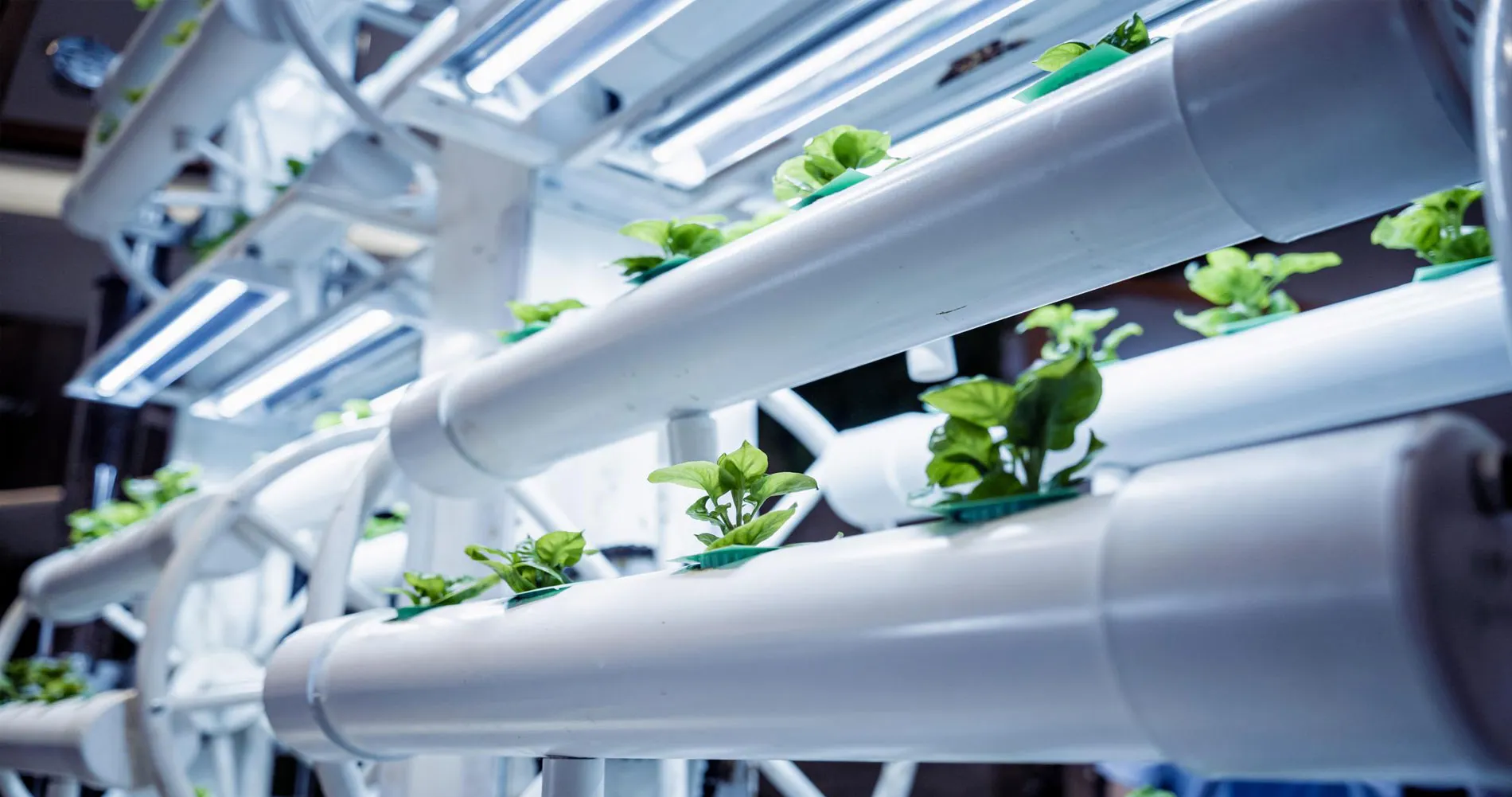
Vertical farming (VF) promises to revolutionize agriculture by maximizing water and space efficiency, enabling year-round crop production, and reducing the need for pesticides. While VF provides fresh, local produce and would be invaluable in urban areas and regions with limited arable land, overcoming the economic and operational obstacles is crucial for VF to become a mainstream solution for global food security.
Alexandra Winterstein
13 January 2026
German version | Russian version | Spanish version
In cities around the world, a quiet revolution is transforming our approach to food production. Vertical farming (VF), which involves growing crops in stacked layers within controlled indoor environments, has captured the imagination of investors, scientists and policymakers alike. As the global population becomes more urbanized and climate change depletes resources, VF offers a vision of fresh, locally produced, sustainable food. However, despite its appealing promise, the industry still faces significant challenges.
At its core, VF focuses on efficiency and control. By growing crops indoors under LED lights using hydroponics (the cultivation of plants in nutrient solution rather than in soil) or aeroponics (the process of cultivating plants in an air or mist environment), farmers can bypass weather and seasons. This enables year-round harvesting, minimizes the need for pesticides, and dramatically reduces water consumption compared to conventional agriculture. In fact, vertical farms can use up to 95% less water, eliminating the need for increasingly scarce arable land as populations grow and cities expand.
As climate change and urbanization intensify, the ability of vertical farming to grow food locally, independent of weather, makes it a vital tool for ensuring future food security. Thea-Isabelle Otto of the Munich-based Association for Vertical Farming states that “Projections say we will need 70% more food by 2050, but already today the food system is a driving force of the destruction of our ecosystems and depleting our resources. This is the result of centralized and industrialized agriculture working against nature rather than in balance with nature.”
Recent research highlights the transformative potential of VF as a means of offsetting this trend. A 2025 study led by TUMCREATE, a research platform based in Singapore, and the Technical University of Munich examined crops as well as algae, mushrooms, fish, insects, and cultivated meat within vertical systems. The findings are astounding: protein yields per area can increase by almost 300 times for crops, and by an astonishing 6000 times for mushrooms and insects, compared to field farming. These systems also reduce the need for pesticides and antibiotics, thereby reducing environmental impact and offering a new path towards food security, especially in dense urban centers or regions affected by extreme weather.
According to the Vertical Farming Report, the VF industry is currently valued at USD 9.6 billion in 2025. This figure is projected to increase to USD 90 billion by 2034, with companies in North America at the forefront. Several factors are fuelling this surge.
Firstly, urbanization is a key driver. With an estimated 80% of the global population expected to reside in urban areas by 2050, the demand for local and resilient food systems is greater than ever before. Secondly, consumers are increasingly demanding organic, pesticide-free, locally grown produce, and vertical farms are well positioned to meet this demand. Lastly, technical advances in automation, LED lighting and multi-layered farming systems are making vertical farms more efficient and productive.
Governments and investors have responded enthusiastically, investing billions in start-ups and established companies alike. Integrating vertical farms with smart city infrastructure and retail spaces is now a major trend, as is expanding into developing countries where food security is a pressing concern. It’s a powerful vision that feels both futuristic and urgently necessary.
Despite this optimism, however, VF is not without its challenges. The capital and operating costs are significant. Creating a high-tech vertical farm can cost around USD 11 million per acre, which is nearly double the cost of a comparable greenhouse. Ongoing expenses, especially for energy, are formidable and can undermine environmental benefits if the electricity is generated from non-renewable resources. Lighting and climate control can account for 30–50% of total operating costs.


Secondly, labor and maintenance costs are high, as sophisticated systems require skilled technicians for management. Routine maintenance is required to prevent costly downtime, adding to the operational burden. Vertical farms also rely heavily on complex automation and monitoring systems. A single technical failure in the lighting, irrigation or airflow systems, for example, can quickly jeopardize entire crops. Profitability thus remains elusive for many operators.
Lastly, crop diversity is limited. Most vertical farms focus on leafy greens and herbs, which grow quickly. Staple crops such as wheat, corn and potatoes do not adapt well to stacked indoor systems.
These challenges have led to a wave of bankruptcies and mergers in the sector. Despite receiving USD 2.4 billion in investment in 2022 alone, many start-ups have failed to grow or become profitable, causing investors to withdraw funding. The VF companies that remain, such as 80 Acres Farms, Oishii, Eden Green Technology, Intelligent Growth Solutions and Stacked Farm, are at the forefront of the industry, driving innovation and shaping the future of sustainable urban agriculture.
The industry is adapting with a renewed focus on adopting renewable energy and more efficient LED technologies to help drive down costs. Optimiziming distribution and logistics is critical to improving margins and delivering fresher produce to urban consumers. To improve diversification, some farms are experimenting with new crops and proteins, and some are even integrating aquaculture or insect farming to maximize yields and resilience.
In 2025, VF is at a crossroads. Its potential to sustainably feed citizens in growing cities is clearer than ever, supported by impressive technological progress and market growth. However, the industry’s future depends on overcoming significant economic and operational challenges. If these can be addressed through innovation, integration and smart policy, VF could become a cornerstone of tomorrow’s food system — a vision that is as necessary as it is promising.