
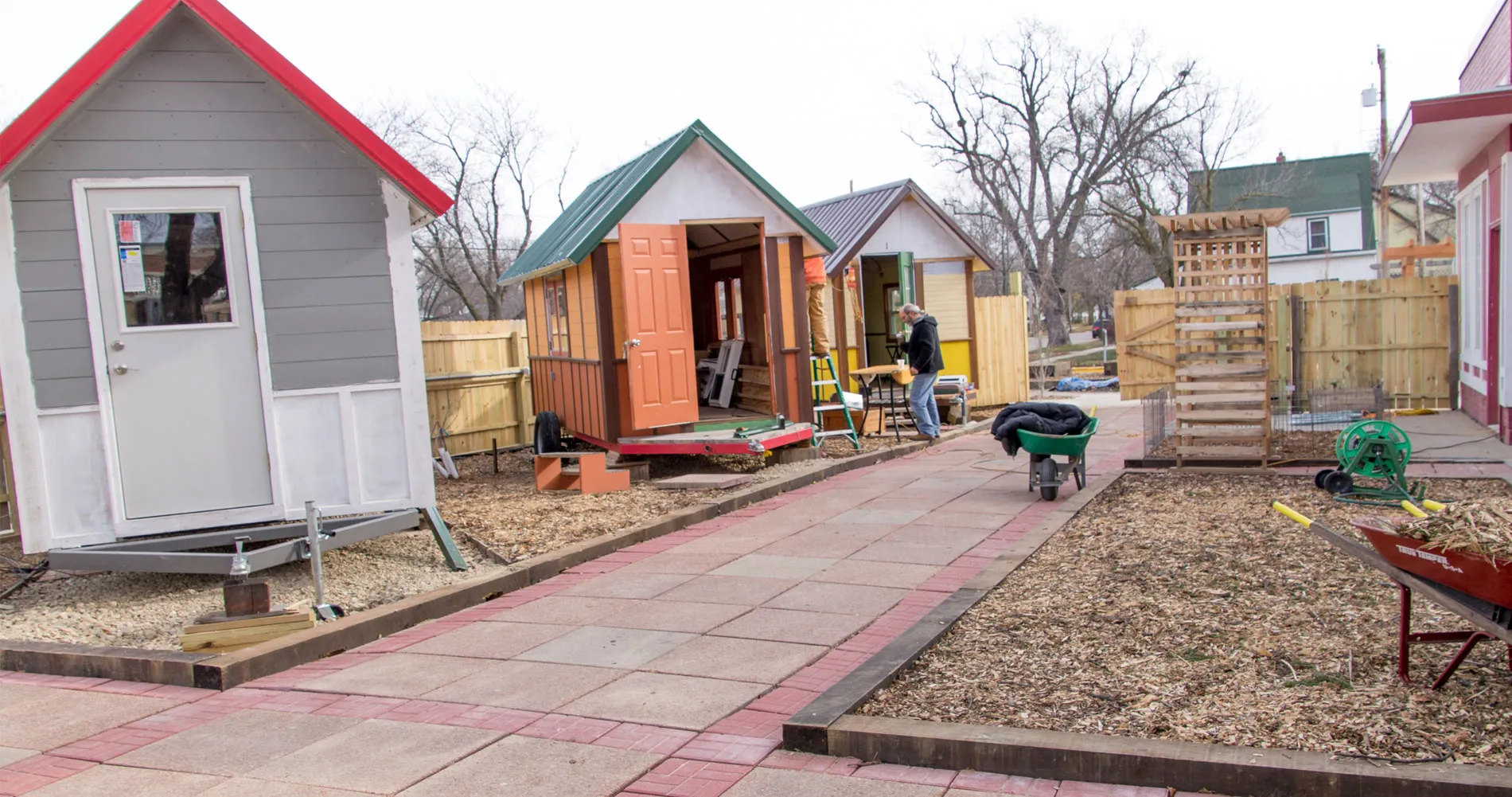
Tech millionaire, Marcel LeBrun, used part of his fortune to build a community of 99 tiny homes in New Brunswick, Canada, to keep people off the streets and offer them a second chance at life.

Anna-Sanziana Beschia
9 March 2026
Canadian tech millionaire Marcel LeBrun is the founder of the 12 Neighbours project in Fredericton, capital city of New Brunswick. LeBrun is a software engineer by trade turned tech tycoon, who made his fortune as the founder and CEO of Radian6, a social media monitoring company. After the sale of Radian6 to American giant, Salesforce, in 2011, he kept working as a senior vice-president at Salesforce. He then moved on to a venture capital firm, Real Ventures, and an automative software company, Potential Motors.
When faced with the decision of what to do next, LeBrun made an extraordinary decision. Instead of building yet another software company, he decided to tackle the issue of homelessness in his native New Brunswick. Following the “housing first” philosophy, where real change begins with one of the most basic needs, a safe and warm shelter, LeBrun developed the 12 Neighbours Community Inc.: 99 tiny homes designed to help the most vulnerable in Fredericton get back on their feet. LeBrun’s mission is not merely to keep people off the streets, but to actively help them find a sense of purpose so they never revert to homelessness.
Canadian magazine, Maclean’s, reports that over the last two decades, Canada’s average home price has increased by 218 percent. While unaffordability is rampant in cities like Toronto and Montreal, it has now also become widespread in small towns like Fredericton.
Tiny homes have boomed on social media in recent years thanks to influencers and fashionable lifestyle content promoting less environmental footprint and less mass consumption. The tiny home movement, which originated in the aftermath of the subprime mortgage crisis of 2007, is also becoming a tool of choice in the fight against homelessness. Across North America, more tiny home villages are sprouting up as a way to keep people off the streets and offer them the possibility of a fresh start. It has also become a lifestyle choice for many environmentally conscious individuals.
The 12 Neighbours website compiles a few documents and links to several peer-reviewed studies which mention that supportive housing (such as 12 Neighbours’ tiny homes) is a highly cost-effective response to homelessness and outperforms shelters. While shelters are big communal transition spaces, supportive housing offers more than just a bed for the night; it also provides structure and, most importantly, a sense of belonging, ownership, and dignity.
Moreover, the 12 Neighbours’ executive summary states that tiny homes can operate at $60 per day (below the $163 per day public cost of street homelessness) resulting in immediate net-savings. In other words, governments and taxpayers save money as more people are housed. A win-win situation for all involved.
Supportive housing is also highly effective in reducing criminality and alleviating pressure on healthcare, therefore reducing the social costs of homelessness. On-site counsellors offer their assistance in the tiny home village, and many residents earn an income by working within the community, e.g. building additional tiny homes, serving coffee at the local cafe, engaging in advocacy etc. This gives individuals a sense of purpose and belonging, as well as a job.
LeBrun travelled across Canada, the US, and Ghana to learn from other tiny homes initiatives and build his own project. Ever since childhood, his curious mind has driven him to solve problems. He approached the issue of homelessness much the same way; yet another problem to solve. He soon put his nerdy qualities and immense fortune to good use to make it happen.
Yet finding land in New Brunswick to build the project proved challenging. The plot of land had to be big enough to welcome a decent-sized community and close to necessary services. It also had to be far enough from downtown Fredericton to avoid the phenomenon of “Not In My Backyard”, or NIMBYism, the opposition of residents to new developments they perceive as undesirable in their neighborhood which might lower property value and make their neighborhood less attractive.
LeBrun soon found a 65-acre plot, previously used for harvesting trees. After securing the land, he came up with a formal business plan and presented it to the provincial and federal housing authorities in New Brunswick. LeBrun and his wife invested about $4.5 million of their own money into the estimated $12 million needed for 12 Neighbours but needed help with the rest. He applied for federal funding in July 2021 and by the time it was approved, 17 months later, LeBrun had already built 35 tiny homes. Various foundations, churches and NGOs in the area were also eager to sign on and contribute to the project.


Construction started in November 2021 when LeBrun assembled a team of 19 carpenters and plumbers, offering them a living wage of between $20 and $30 per hour. After trying out two or three prototypes, the team settled on the current model.
Each tiny home is 22.3 square meters, equipped with a bathroom, combined kitchen and living space, heating, and solar panels. Tiny homes are made of pine wood and metal in a massive, donated, 743 square meters warehouse, finished on a trailer, and then brought intact to the 12 Neighbours site.
Eventually, community members joined the building team which could produce a new tiny home every four days. The residents live mostly solo, though sometimes as a couple, and they range in age from 18 to 70. Residents spend 30% of their income on rent (most of them are on social assistance), roughly C$200 (Canadian dollars) per month, with utilities and internet included.
12 Neighbours is an entire social enterprise designed to foster self-sufficiency among the most vulnerable and to provide them with new skill sets. Aside from safe supportive housing (which should always come first, according to LeBrun).
12 Neighbours also features a “neighbourly café” and “neighbourly ventures”: a programme designed to “create sustainable livelihoods” through “hands-on training, meaningful employment, and entrepreneurship support”. LeBrun built a community from the ground up comprising housing, retail shops and community gardens, with little delineation between staff and residents.
There is, of course, a selection process to get access to communities like 12 Neighbours. These initiatives can only help a small number of homeless people, typically not the most critical cases. Critics have pointed out that tiny home villages, such as 12 Neighbours, should have a much smaller concentration of people to avoid social stigmatization. To this, LeBrun replies that one of the things residents need and crave the most is a community. After all, the most successful philanthropic projects address more than just material deprivation, they also fill a social void.