
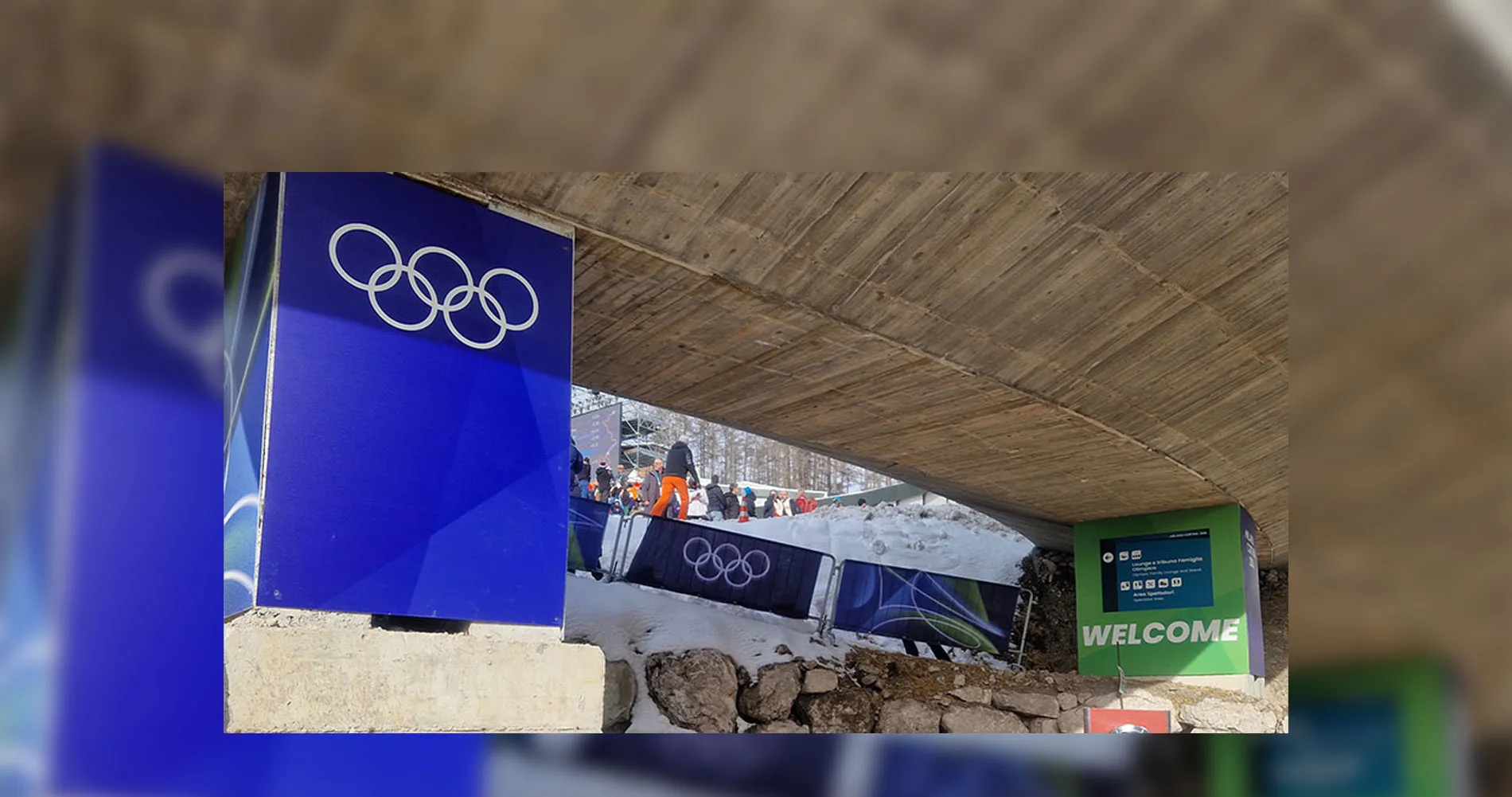
iGlobenews visited the Olympic Games in Cortina. Promoted as the most environmentally friendly Winter Games ever held, the 2026 Olympics in Cortina promise to “adapt to the territory”. Yet from destroyed larch forests to billion-euro road projects, critics claim that the truth of the Dolomite event tells a very different story — particularly when compared to the first Innsbruck and Cortina’s 1956 Games.
Alexandra Dubsky
24 February 2026
German version
The 2026 Milano Cortina Winter Olympics started with an ambitious promise: to be more sustainable than any previous Winter Games. Organizers highlighted existing venues, iconic Alpine settings, and limited permanent construction. According to the official bidding report, the word “sustainability” was cited more than 100 times — apparently a first in Olympic history. Authorities vowed that the event would “adapt to the territory, not vice versa.”
Cortina, the so called “pearl of the Dolomites”, was historic for hosting the first Winter Games 1956 to be broadcasted internationally. This year’s Milano–Cortina Games relied heavily on that legacy, presenting itself as a return to Alpine authenticity, but this time with modern environmental awareness.
Prior to the opening ceremony, the Milan–Cortina Foundation asserted that 85% of the Olympic infrastructure was already in place or would be temporary. That figure has become central to the sustainability narrative, and equally fundamental to those questioning this claim.
The Alpine venues lie in midst of the Dolomites, a recognized UNESCO world heritage site. Italy’s bid promised to use the Games to “showcase the importance of protecting sensitive mountain ecosystems.” However, environmental groups such as Mountain Wilderness Italia believe that this claim could not be further from the truth. Besides the very prominent, expensive new sporting venues, critics point to additional and widened roads, expanded parking areas, and kilometers of pipelines, especially erected for snowmaking systems.
“Cortina is known as Queen of the Dolomites. But we should rename her the ‘Queen of Cement,'” said 70-year-old Luigi Casanova, director of Mountain Wilderness, describing the small town where prior to the opening ceremony more than 20 cranes dotted the landscape.
The International Olympic Committee had initially suggested to hold the bobsled events in Innsbruck, Austria, where there is already a world-class track in place. But Matteo Salvini, Italy’s deputy prime minister and transport and infrastructure minister, refused the idea and made holding the sporting event only on Italian soil a national issue. “The Games must be Italian games,” Salvini wrote on X in February 2024. He blamed environmentalists for aiming to “sabotage” the Olympics and of betraying Italy “in front of the whole world.”
Approximately 800 century-old larch trees were cut down to build the new sliding track. “These are trees that survived two world wars,” said Casanova, “… But they couldn’t survive the vandals of 2025.”
The new sliding track replaced Cortina’s 1956 track, which closed in 2008 due to high maintenance costs. Critics note the historical parallel to Turin’s Cesana Pariol track – built for the 2006 Olympic games, it was subsequently shut down in 2011 for similar financial reasons.
Yet even this sad fact is not the most glaring contradiction to the “sustainability” argument. Perhaps the strongest sustainability contradiction represents the massive amounts of artificial snow. Estimates have suggested that the Games will require some 84.8 million cubic feet of water, an equivalent of about 380 Olympic swimming pools, just for snowmaking alone. Depending on weather conditions this amount of water will have produced 56 million to 848 million cubic feet of artificial snow.
Water for the snow making process was drawn from Alpine rivers such as the Boite, with energy-intensive pumping systems operating nonstop, in a region where climate scientists argue that winter sports may only be possible for a few more decades due to rising temperatures. Unlike 1956, when natural snowfall sufficed, and one skating event was even held on a frozen lake, the 2026 Games depended heavily on artificial snow infrastructure.
According to Time, a 2023 Canadian study found that producing 1.4 billion cubic feet of snow during an average winter requires an estimated 478 000 megawatt-hours (MWh) of electricity per year. The result is 130 095 metric tons of associated carbon emissions. Using these figures to make a rough estimated of the amount of electricity required to produce snow with 84.8 million cubic feet of water comes to a staggering 220 000 MWh of electricity. This would translate into enough electricity to support between 20 000 to 20 700 households for an entire year.
What about the Olympic Village? After the games, a total of 377 temporary units will be dismantled, at a cost of €38 million, over €2 million per day across the 17-day event, excluding disposal. The buildings are far from traditional Alpine architecture, which historically favored local materials and minimal land adaptation.
The asphalt required to build the infrastructure is also a far cry from “sustainable”. Roughly €3 billion was spent on road infrastructure, only €700 million was invested in rail projects to improve the roughly 400 kilometers between Milan and Cortina. Critics argue that prioritizing asphalt over rail contradicts climate-conscious transport goals.
Most guests arrived to the 1956 Winter Olympics by train on lines that have since vanished. Facilities were humble by today’s standards, and natural snow defined each competition. The Games improved the local economy without additional road expansion or the kind of artificial snow systems that are needed today. Environmental consciousness was hardly known, but so were mega infrastructure ventures purely built for the spectacle.
Cortina has lived off its infrastructure developments from the last Olympic games in the 1950s, said Filipo Scrocco, local real estate broker from Cortina, to iGlobenews. “All these new enhancements, no matter if we look at the hotels, the roads, parking, the sport facilities, etc, have been very much needed for a while and will boost tourism in the close future. Especially American visitors like to combine sightseeing in Venice with skiing in Cortina, two cities that are only a two-hour bus ride away from each other. … The Winter Olympics helped to raise Cortina’s global image and to put it back onto the international map”, he argued.


Yet the 2006 Winter Olympics of Turin which were praised for urban regeneration within the Turin region do not support this claim. After the Games several mountain venues were hardly used or completely abandoned, particularly the Cesana Pariol bobsleigh track. The Tyrolian capital Innsbruck, a repeat Olympic host, has often demonstrated the reuse of existing infrastructure, hence limiting new construction. The IOC’s suggestion to relocate sliding events to Austria was the logical consequence of a sustainable strategy, which the Italian organizers declined.
Milano–Cortina 2026 was an Italian national prestige project with many athletic highlights and new Olympic records. The two-week Games had no visible glitches. What the Games were not was “sustainable”. This was the real price for such a mega sports event – our modern day “bread and circuses”.